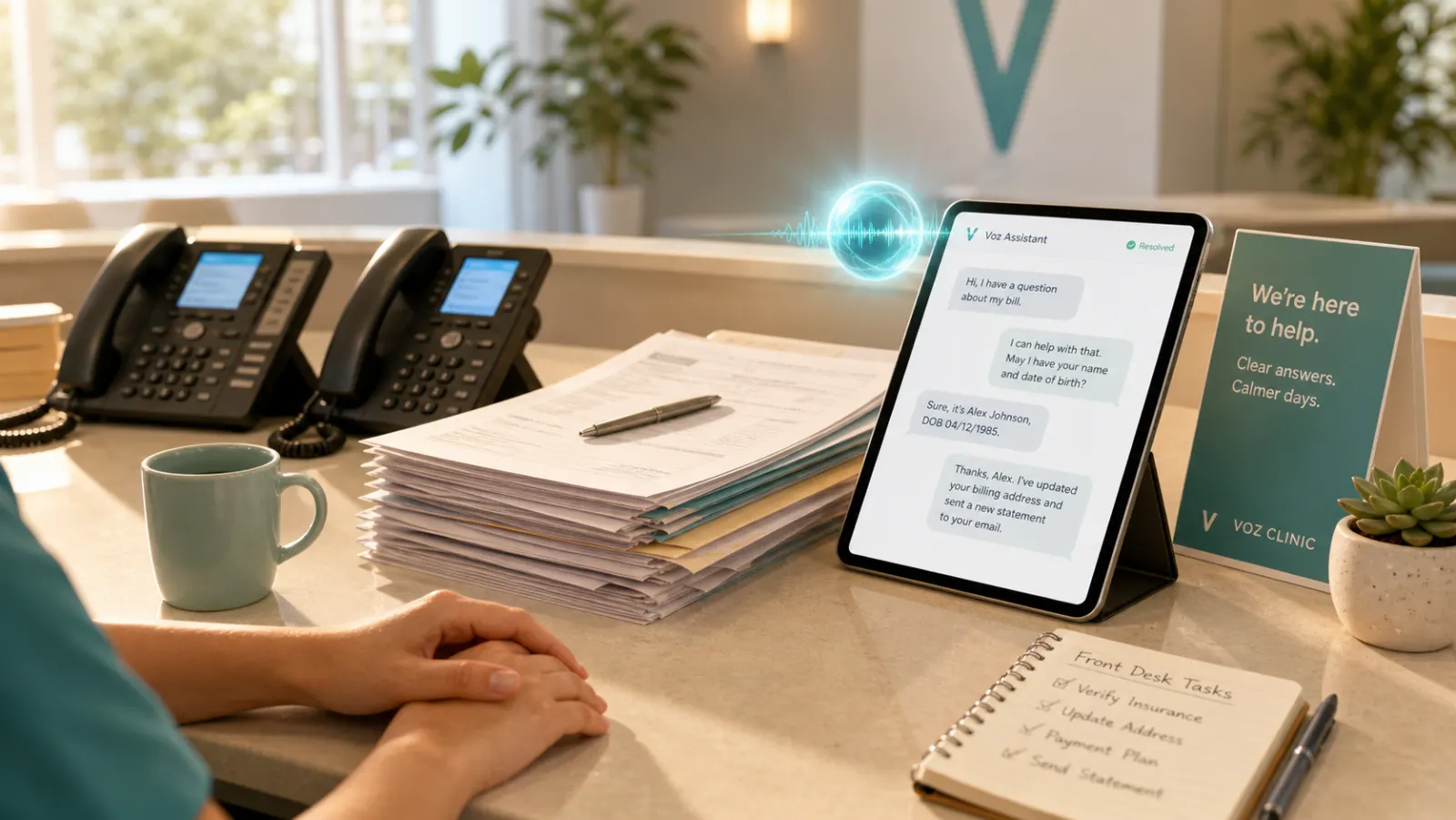
Nobody hired your front desk to be a search engine.
They were hired to run the clinic: to greet patients, to keep the schedule honest, to keep the doctor moving, to handle the human moments that actually require a human. Instead they spend most of the day answering the same forty questions, in two languages, while a second line rings and a WhatsApp thread goes unread.
Here are the seven tasks a bilingual AI voice agent takes over completely, and what your team gets back when it does.

1. Answering the same questions, fifty times a day
Hours. Address. Parking. Do you take my insurance. Does the doctor speak English. How long does the procedure take. Can I go back the same day.
These questions have fixed answers. They do not need judgment, empathy, or clinical training. They need speed and consistency, in whichever language the patient asked in.
What the agent does: answers instantly, correctly, and identically every time, at 3 PM or 3 AM. What your staff gets back: the single largest block of wasted time in the clinic.
2. Booking the appointment
The whole point of every inbound message is a slot on the calendar. Yet the booking usually takes three or four exchanges: the patient asks, someone checks the calendar, offers a time, the patient replies hours later, the slot is gone, start over.
What the agent does: checks the live calendar, offers real open times, confirms, and writes the appointment straight into Google Calendar, Outlook or Open Dental. What your staff gets back: no more calendar ping-pong, and no more double bookings.
3. Chasing confirmations and sending reminders
Every clinic knows reminders reduce no-shows. Very few clinics send them consistently, because it means someone remembering to do it, twice, for every appointment on the schedule.
What the agent does: sends a reminder 24 hours out and again 2 hours out, on WhatsApp, in the patient's language, and reschedules the ones who say they cannot make it. What your staff gets back: a schedule that holds, and a chair that is not sitting empty at 2 PM.
4. Verifying insurance before the patient arrives
The worst place to discover a coverage problem is at the chair, with the patient already in the room and the treatment plan already explained. That is where cancellations, awkward refunds, and bad reviews come from.
What the agent does: confirms coverage and eligibility with the patient in advance, so the money conversation is finished before anyone crosses a border. What your staff gets back: no surprises, and no more explaining a bill someone did not expect.
5. Taking calls the front desk cannot pick up
The line is busy. The team is with a patient. It is lunch. It is 8 PM. The phone rings out, and almost nobody calls back a missed call from a Tijuana clinic they have not chosen yet.
What the agent does: answers on its own direct phone number, in Spanish or English, captures the patient's information, and books. It can place outbound calls too. What your staff gets back: the leads that were quietly evaporating, and a phone that stops being a source of guilt.
6. Working the inactive patient list
Six-month cleanings, annual exams, post-op follow-ups, the second implant on the treatment plan. Everyone agrees this is the highest-ROI thing a clinic can do. Almost nobody does it, because it is weeks of manual work that is never on fire.
What the agent does: watches the dates, messages the patient when the window opens, handles the reply, and books the slot. What your staff gets back: revenue from patients who already trust you, without a single spreadsheet. (More on this in reactivation and annual recall.)
7. Being bilingual, all day, every day
Your one or two English-speaking staff are your most expensive and most in-demand people. Making them the bottleneck for every message from a San Diego, Los Angeles or Phoenix patient is an expensive way to run a clinic.
What the agent does: speaks natural Spanish and natural English, switches mid-conversation when the patient does, and includes border-crossing detail in English automatically. Not a translation layer. What your staff gets back: their actual job.
What is left for the humans
Everything that matters.

Emergencies. Complaints. Complex cases. The nervous patient who needs to hear a real voice before agreeing to surgery in another country. The judgment calls. The relationships.
The agent escalates all of it, immediately. It never invents a price, a diagnosis, or a medical promise. It is a front desk that never sleeps, not a replacement for the people who make your clinic worth choosing.
Book a demo
Book a 20-minute call and we'll show you Sofía handling your clinic's real cases, in Spanish and English.
Questions? Email us at hola@vozclinic.com.
← Back to the blog