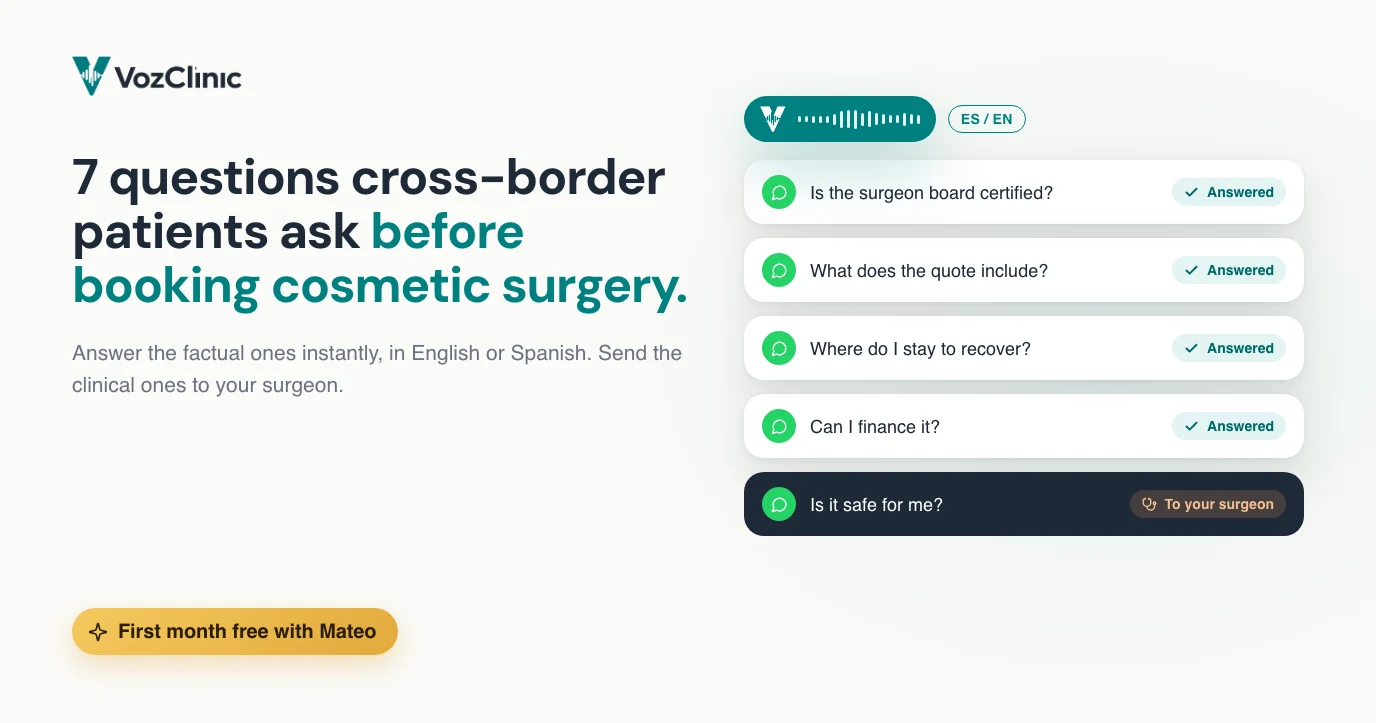
A cosmetic surgery patient coming from the US does not decide on a whim. They read, they compare, and before they ever pay a deposit they send a surgeon the same handful of hard questions. For a Tijuana practice, those questions are not an annoyance, they are the whole funnel: the clinic that answers them first, clearly, and in the patient's own language usually wins a case worth far more than a routine visit. The problem is that the questions arrive at 9pm, on a weekend, in two languages, while your surgeon is in the OR and your coordinator is already gone for the day.
Short answer: Before booking cosmetic surgery in Tijuana, cross-border patients consistently ask about the surgeon's credentials, exactly what the quoted price includes, recovery lodging, how cross-border follow-up works, financing, safety and accreditation, and travel logistics. A bilingual AI voice agent answers the factual ones instantly from the facts your clinic sets, and routes anything clinical, like whether a procedure is safe for a specific patient, to your surgeon in seconds, so the inquiry turns into a booked consultation instead of a message that goes cold.
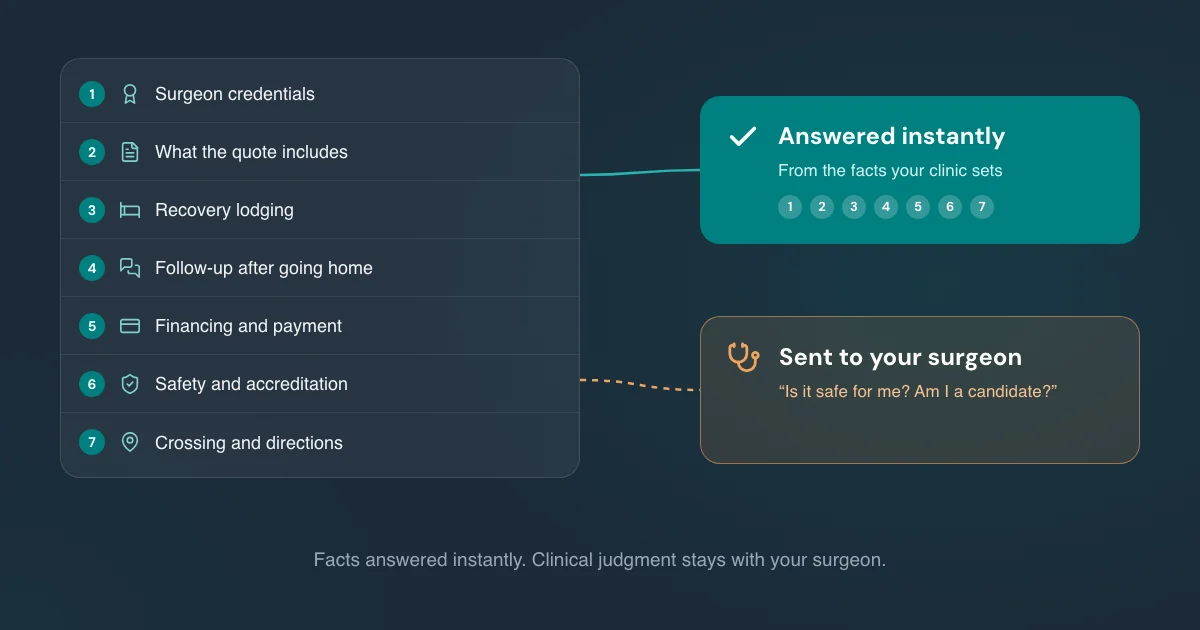
Here are the seven, and how a bilingual voice agent handles each one without inventing anything.
1. Is the surgeon board certified and how experienced are they?
This is almost always the first question, because a cross-border patient is trusting a stranger with an irreversible procedure. They want to know the surgeon's certification, specialty, and track record before anything else. A voice agent answers this instantly from the credentials and background your clinic has given it, such as the surgeon's certification and years in practice, in whichever language the patient asked. It presents the facts you provided, it does not editorialize or inflate them, and if the patient wants documentation or specifics you have not loaded, it tells them the clinic will share those and routes the request to your team. Answering this one fast and plainly is what moves a nervous prospect to the next question instead of the next clinic.
2. What exactly does the quoted price include?
The second question, and the one that most often blows up a deal later. Patients want to know whether the quote covers the surgeon's fee, anesthesia, the facility, implants or materials, post-op garments, medications, and nights of recovery, or whether those are separate. A voice agent explains only the inclusions and packages you have defined, line by line, so the patient gets a straight answer the moment they ask instead of waiting a day for a callback. It never invents a number or a line item. For anything custom or quote-specific, it tells the patient the surgeon or coordinator will confirm and hands the thread over, which keeps the trust intact and the case alive.
3. Where do I stay and recover after surgery?
Recovery lodging is a real logistical worry for someone having surgery hundreds of miles from home. Patients ask whether the clinic has a recovery house, a partner hotel, or a recommended place to stay, and how many nights they should plan for. A voice agent answers from your clinic's actual recovery arrangements and stated recovery timelines, around the clock, so a patient planning the trip gets the information while they are still motivated. Because it works on WhatsApp in both languages, it can walk a patient through lodging and recovery logistics in the same thread where they are weighing the procedure, which is exactly where the booking is won or lost.
4. How does follow-up work once I go back across the border?
This is the question that separates serious surgical shoppers from browsers, and the one general clinics answer worst. A patient wants to know what happens after they drive home: how post-op checks work remotely, who they message if something concerns them, and whether they come back for an in-person follow-up. A voice agent explains your clinic's follow-up protocol as you have set it, and, just as importantly, it becomes the always-open channel for that follow-up, answering post-op logistics messages instantly and escalating any clinical concern to the surgeon in seconds. Showing a patient there is a real, bilingual line of contact after surgery is a powerful reason to book with you over a clinic that goes silent at the border.
5. Can I finance it, and what are the payment options?
Cosmetic surgery is a large out-of-pocket cost, so patients ask early about deposits, payment plans, financing, and accepted payment methods. A voice agent answers from the payment and financing options your clinic actually offers, including deposit terms and what you accept, so a patient can gauge affordability without a phone call during business hours they may not have. It quotes only the terms you have loaded and never improvises a financing offer. When a patient is ready, it moves them straight to booking the consult, turning a money question into a scheduled conversation with your team.
6. Is it safe, and is the facility accredited?
Safety is the deepest worry a cross-border surgical patient carries, and it deserves careful handling. A voice agent shares the factual, verifiable things your clinic has given it, such as your facility's accreditations, certifications, and protocols, in plain language. What it does not do is make safety judgments or promises, because whether a specific procedure is safe for a specific patient is a medical decision. The agent presents your stated accreditations and then routes any real clinical safety question, about the patient's own health, risks, or candidacy, to your surgeon in seconds. Handling this question honestly, with facts plus a fast human handoff, builds more trust than any oversell ever could.
7. How do I cross the border and get to the clinic?
The last practical hurdle is the trip itself: where to cross, how long it takes, parking, whether someone meets them, and how to reach the clinic from the San Ysidro or Otay crossing. A voice agent answers all of it from your clinic's directions and crossing guidance, in English or Spanish, at whatever hour the patient is planning. Removing the friction of the trip is often the final nudge that converts a decided patient into a booked one, and it is exactly the kind of repetitive logistics question that should never pull your coordinator away from a patient who is ready to sign.
The pattern behind all seven
Notice what every one of these has in common. The factual layer, credentials you provided, inclusions you set, lodging, follow-up protocol, payment terms, accreditations, directions, gets answered instantly, in the patient's language, at the hour they actually ask. The clinical layer, whether surgery is safe or right for this specific patient, always goes to your surgeon. That split is the whole design: a bilingual voice agent is the fast, accurate, always-on front door for a high-ticket cross-border decision, and your surgeon keeps every judgment that belongs to a surgeon. For the full picture of what the agent does across a surgical practice, read what a bilingual voice agent actually does for a Tijuana cosmetic surgery practice and the medical-tourism pillar, the bilingual voice agent built for Tijuana medical tourism clinics.
Frequently asked questions
What questions should patients ask before cosmetic surgery in Tijuana?
Cross-border patients consistently ask about the surgeon's credentials, exactly what the quoted price includes, recovery lodging, how cross-border follow-up works, financing and payment options, safety and facility accreditation, and how to cross the border and reach the clinic. These seven questions make up most of the decision, and the clinic that answers them first and clearly tends to win the case.
Can a voice agent answer these cosmetic surgery questions for my clinic?
Yes, for the factual ones. A bilingual voice agent answers the credential, inclusion, lodging, follow-up, payment, accreditation, and travel questions instantly, in English or Spanish, using only the facts your clinic loads during setup. It never invents prices, results, or promises, and it routes anything clinical to your surgeon in seconds.
Does the agent decide whether a procedure is safe for a patient?
No. The agent shares the factual accreditations and protocols your clinic provides, but it never makes a medical safety judgment. Whether a specific procedure is safe or appropriate for a specific patient is always escalated to your surgeon, with the full conversation context, so a real person follows up quickly.
Why does answering these questions quickly matter so much?
Because a cosmetic surgery patient comparing clinics will not call back. The decision takes weeks and the first clinic to answer clearly, in the patient's language, usually keeps the lead. A voice agent answers the moment the question lands, including the after-hours and weekend messages that otherwise die in a voicemail box.
Does it work in English for US patients?
Yes. The agent is natively bilingual and answers English-speaking patients in natural English and Spanish-speaking patients in natural Spanish, switching mid-conversation if needed. For a Tijuana practice whose surgical pipeline depends on US inquiries, that fluency keeps a comparison-shopping patient engaged instead of moving on.
VozClinic is available now
VozClinic is available now, with no waitlist. Book a 20-minute demo with Mateo and your clinic gets its first month free. See how a bilingual voice agent answers your cross-border surgical inquiries the moment they land at www.vozclinic.com, or send your questions to hola@vozclinic.com. Hecho en Tijuana.
← Back to the blog