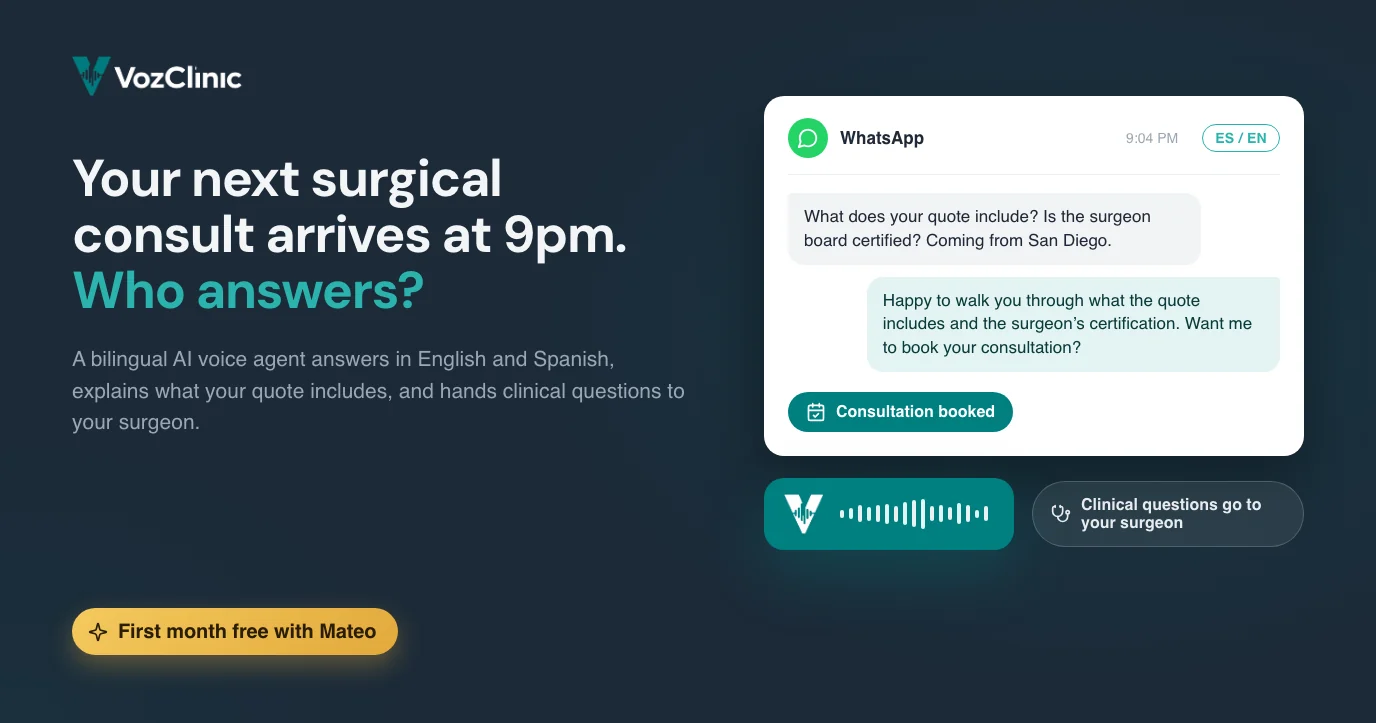
A cosmetic surgery practice does not lose money on missed cleanings or walk-ins. It loses money one high-ticket consult at a time. Someone in San Diego has been researching a procedure for weeks, finally sends a WhatsApp message at 9pm asking what your quote includes and whether the surgeon is board certified, and if nobody answers that night, they send the same message to two other Tijuana practices before morning. Whoever replies first, in the patient's own language, with real answers instead of "we will call you back," usually wins the consult. For a surgical practice, that one consult can be worth more than a month of routine visits at a general clinic.
That is the shape of cosmetic surgery demand, and it is why the vertical behaves differently from a dental office or a med spa. The decision is big, the research is long, the patient is often across the border, and the questions that come in are a mix of things your front desk can answer in seconds and things only your surgeon should. An AI voice agent for cosmetic surgery clinics is built to answer the first kind instantly, route the second kind to the right person fast, and make sure none of it falls into a voicemail box overnight.
Short answer: An AI voice agent for a cosmetic surgery clinic answers every phone call and WhatsApp message in English and Spanish, around the clock, on your existing number, so cross-border consult requests never go to voicemail. It qualifies new inquiries, explains what your quoted packages include based only on the facts you set, books consultations into your calendar, sends pre-op and follow-up reminders, and escalates clinical and safety questions to your surgeon or coordinator in seconds. VozClinic trains its agent, Sofía, on your practice's real procedures, inclusions, and policies in a single 90-minute session, and most practices are answering live patients within about a week.
What does an AI voice agent do for a cosmetic surgery clinic?
It picks up the inquiries that decide whether a consult happens at all. For a surgical practice the most valuable message of the week often arrives when no coordinator is at a desk, late at night or on a weekend, from someone comparing two or three surgeons. Sofía answers it the moment it lands, in the language the patient wrote in, and moves the conversation toward the one outcome that matters here: a booked consultation with your surgeon, written into your real calendar, not a promise that someone will follow up.
Around that core booking job, the agent handles the repetitive work that a cosmetic coordinator would otherwise spend their day on. It qualifies who is a real surgical prospect and who is price-shopping a procedure you do not offer, answers the logistics questions that come up over and over, explains what a quoted package includes from the facts you have given it, and runs the reminder sequence that keeps a scheduled consult from quietly evaporating in the weeks between first contact and surgery. The listicle paired with this post, 7 questions cross-border patients ask before booking cosmetic surgery in Tijuana, walks through the exact questions it fields and where it draws the line.
Why is the cosmetic surgery funnel different from a walk-in clinic?
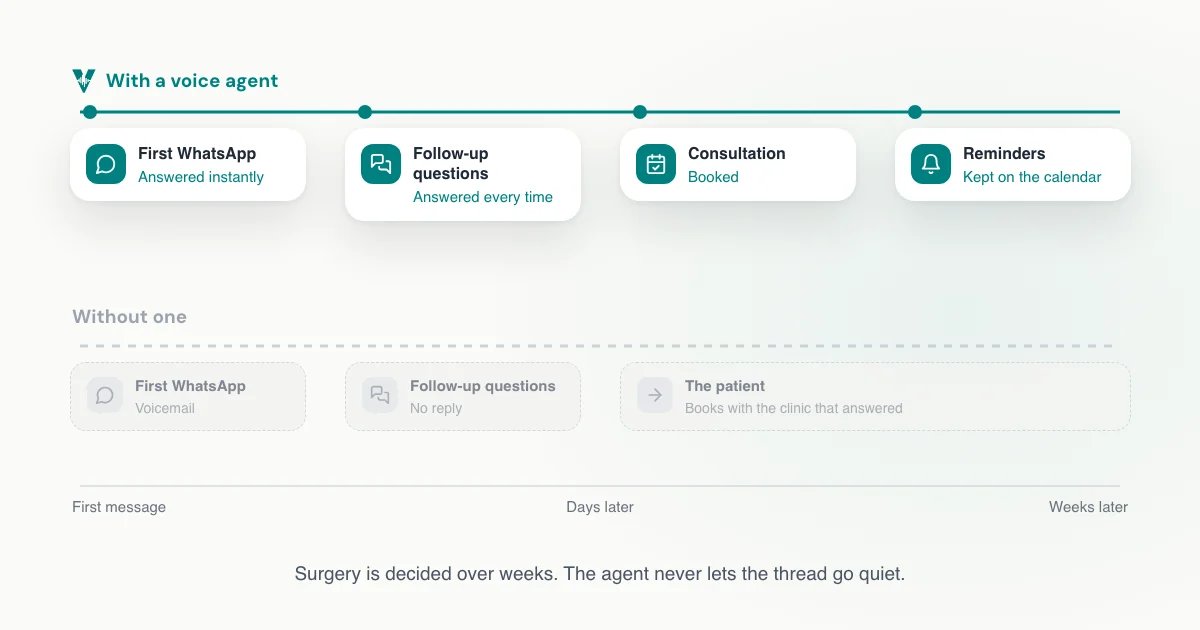
Because almost nobody books surgery on the first message. A cosmetic procedure is a researched, high-cost, emotionally loaded decision, and the patient usually travels for it. That means the gap between "first WhatsApp" and "deposit paid" is measured in weeks, and anything that goes quiet in that gap is a lost case. A dental office can survive a slow reply because the patient has a toothache and will call back. A surgical prospect comparing clinics will not call back. They will book with the practice that stayed responsive.
A voice agent is suited to exactly this long, high-stakes funnel because it never drops the thread. It answers the first inquiry instantly, keeps answering the follow-up questions that come in over the following days, and nudges the patient toward a consult without your coordinator having to live inside the inbox. For a cross-border surgical practice, speed and continuity of response are not a nicety, they are the difference between a booked surgery and a patient who went with the clinic that answered faster. We make that case in detail in speed to lead for medical tourism.
Why does a Tijuana cosmetic surgery practice need it to be bilingual?
Because your demand is split across two languages and one border. A large share of cosmetic surgery patients in Tijuana come from the United States and want to handle the most important decision of the year in English, while your local patients and your own team work in Spanish. A translated chatbot that runs everything through machine translation reads as exactly what it is, and for a decision this personal, a stilted reply erodes the trust a surgical patient is specifically shopping for.
Sofía is natively bilingual. It answers an English speaker in natural English and a Spanish speaker in natural Spanish, in the same warm, Tijuana-local voice, and it switches mid-conversation if the patient does. For a practice whose new-patient pipeline depends on cross-border inquiries, being genuinely fluent in both languages is not a feature, it is the price of being taken seriously by the patient who is about to choose a surgeon.
How does the agent explain what a quote includes without inventing a number?
It only ever says what you told it to say. This matters more in cosmetic surgery than almost anywhere, because the question "what does the price include" is where patients get burned and where trust is won or lost. Sofía quotes only the inclusions, packages, and policies you load during setup, such as what a surgical quote covers, what is separate, deposit and financing options you actually offer, and your stated consultation fee. If a patient asks something you have not defined, it does not guess, it tells the patient the surgeon or coordinator will confirm and routes the question to your team.
This is a deliberate guardrail, not a limitation. The agent never fabricates a price, a result, or a promise about an outcome, because inventing any of those in a surgical context is both a trust problem and a safety problem. It handles the factual, logistical layer of the quote instantly and honestly, and it leaves anything that requires the surgeon's judgment to the surgeon.
Where does the agent hand a clinical or safety question back to your surgeon?
The moment a question stops being logistics and becomes medicine. Whether a patient is a candidate for a procedure, what results they can expect, how their health history affects their options, what the real risks are, whether it is safe for them specifically, all of that is the surgeon's call, and the agent is built to recognize it and escalate in seconds rather than answer it. Sofía passes the question, with the full conversation context, to the person you designate, and tells the patient a human from the practice will follow up.
It works the same way for the sensitive moments a surgical practice has to handle with care: a complication concern, an urgent post-op message, a frustrated patient. The agent is a fast, accurate front door, not a substitute for your clinical team, and the handoff is instant and logged. Your surgeon keeps every clinical and safety judgment. The agent just makes sure the patient reached a real person quickly instead of a full voicemail box.
What a cosmetic surgery practice gets back over a month
A month in, the pattern is consistent: the after-hours and cross-border inquiries that used to die in voicemail are now answered the minute they arrive, qualified, and either booked or routed. The coordinator stops spending the day retyping the same answers about inclusions and logistics and spends it on the patients who are close to deciding. Consultations that were booked weeks out actually show up, because the reminder sequence kept the thread warm. And every conversation is captured, bilingual, and compliant with Mexico's LFPDPPP, with consent taken in the chat and an auditable log, which matters when the patient is handing you a medical decision.
None of this replaces your surgeon or your coordinator. It removes the reason high-value consults slip away, which is almost never the quality of your work and almost always the speed and language of the first reply.
Where to read next
Start with the hub, AI for medical clinics: what a bilingual voice agent actually does, for the full picture of what the agent handles across any practice. Then read the companion listicle, 7 questions cross-border patients ask before booking cosmetic surgery in Tijuana, and speed to lead for medical tourism for why answering first wins the cross-border case.
Frequently asked questions
What does an AI voice agent do for a cosmetic surgery clinic?
It answers every call and WhatsApp message in English and Spanish, 24/7, on your existing number, so cross-border consult requests never hit voicemail. It qualifies inquiries, explains what your quoted packages include from the facts you set, books consultations into your calendar, and escalates clinical or safety questions to your surgeon. The goal is to catch and convert the high-value consults that used to slip away after hours.
Can an AI voice agent qualify and book cosmetic surgery consultations?
Yes. It identifies whether an inquiry is a real surgical prospect for a procedure you offer, answers the logistics and inclusion questions that come first, and books a qualified consultation straight into your calendar with the right coordinator or surgeon. It also runs pre-consult and follow-up reminders so a consult booked weeks out does not quietly fall off.
Will it answer cross-border patients in English?
Yes. Sofía is natively bilingual and answers English-speaking patients in natural English and Spanish-speaking patients in natural Spanish, switching mid-conversation if the patient does. For a Tijuana practice whose pipeline depends on US inquiries, that fluency is what keeps a comparison-shopping patient engaged instead of moving on.
How does the agent handle pricing and what a quote includes?
It quotes only the inclusions, packages, deposit terms, and consultation fees you load during setup, and never invents a number. If a patient asks about something you have not defined, or about a custom surgical quote, it tells them the surgeon or coordinator will confirm and routes the question to your team. It handles the factual layer instantly and leaves pricing that needs the surgeon's judgment to the surgeon.
Is it safe to let AI answer questions about surgery?
The agent answers logistics, inclusions, and scheduling, and it is explicitly built to escalate anything clinical, such as candidacy, expected results, risks, health history, or whether a procedure is safe for a specific patient, to your surgeon in seconds. It never gives medical advice or safety assurances on its own. Every conversation is logged and LFPDPPP-compliant, with consent captured in the chat.
VozClinic is available now
VozClinic is available now, with no waitlist. Book a 20-minute demo with Mateo and your practice gets its first month free. See how a bilingual voice agent handles your cross-border cosmetic surgery inquiries at www.vozclinic.com, or send your questions to hola@vozclinic.com. Hecho en Tijuana.
← Back to the blog