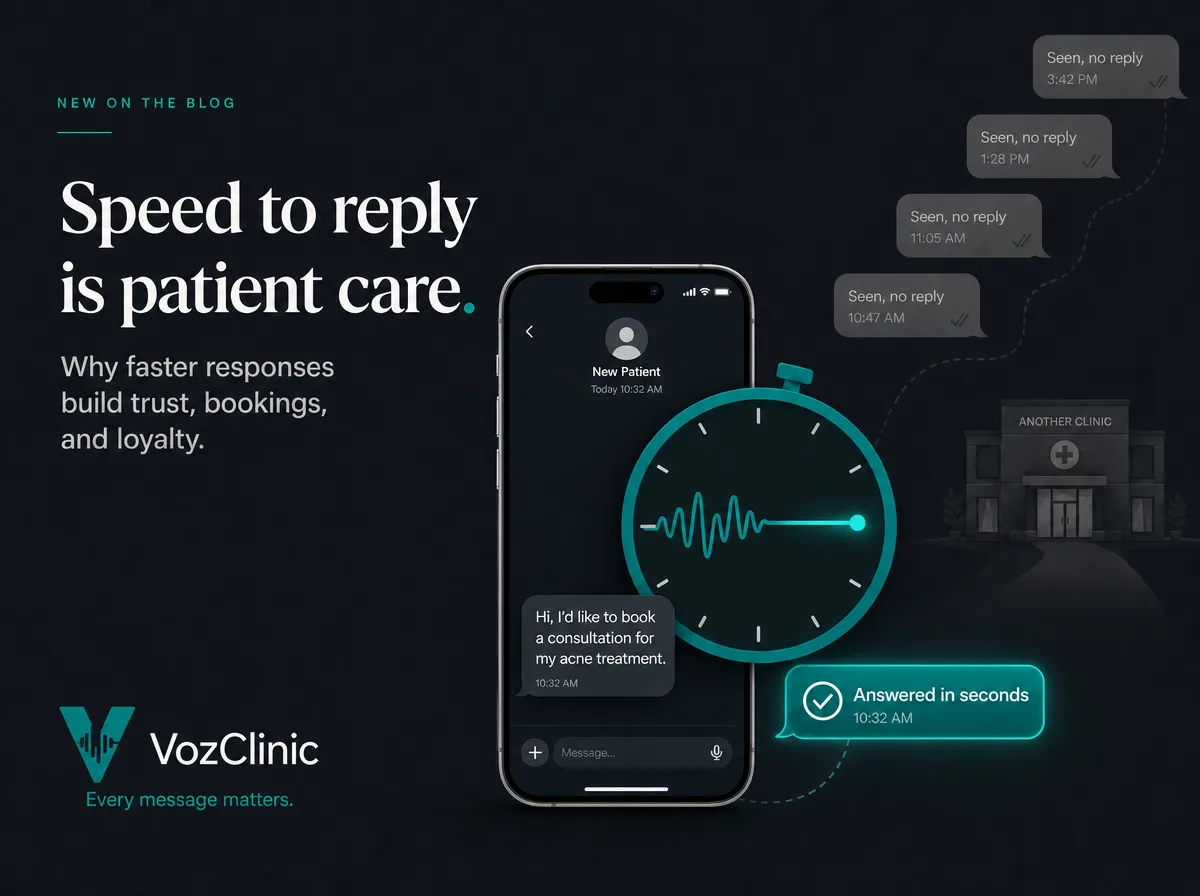
Slow response time is the most expensive problem a clinic never sees on a report. The patients you lose to it do not complain and do not call back. They just message the next clinic and book there instead. Nothing shows up in your system except a slow, quiet drift of inquiries that never turn into appointments, and it is almost always blamed on the market, the price, or the competition, when the real cause is how long it took to reply.
Here are five signs your clinic response time is costing you patients, and what a bilingual AI receptionist does about each one.
1. Your first reply takes hours, not seconds
The single number that decides whether a new patient books with you is how fast the first reply lands. A cross-border patient who writes at 9 p.m. is not waiting; they are messaging two or three clinics and going with whoever answers first. If your average first reply is measured in hours, you are not competing on care or price, you are losing before those even come up. The fix is answering in seconds, every time, at every hour. A bilingual AI receptionist replies the instant the message arrives, in English or Spanish, so the fast answer that wins the patient is yours instead of the clinic down the street.
2. After-hours and weekend messages pile up until morning
Look at when your patients actually reach out. For a border clinic serving San Diego, Los Angeles, and Phoenix, a large share of it happens at night and on weekends, exactly when nobody is at the desk. If your inbox fills up after closing and gets worked through the next morning, every one of those messages sat overnight next to a patient who was ready to book. By the time you reply, the trip got planned around a clinic that answered sooner. An always-on receptionist closes that gap by treating 11 p.m. Saturday the same as 11 a.m. Tuesday, so no message waits for office hours to get an answer.
3. You get plenty of inquiries but few of them book
This is the sign clinics miss most, because the top of the funnel looks healthy. The calls come in, the messages arrive, the ad spend is working. But the bookings do not match the interest, and the gap gets chalked up to tire-kickers. Often it is not the interest that is weak, it is the response that is slow. Interested patients cool off fast when the reply lags, and a warm lead goes cold in the hours it takes to get back to them. Fixing response time is usually the cheapest way to lift bookings, because you are not buying more leads, you are keeping the ones you already paid for from slipping away.
4. English-speaking patients stall or drop off before booking
If your cross-border inquiries start strong and then go quiet, response time in the wrong language is often the reason. A call or message in English that your front desk cannot answer right away does not just wait, it stalls, because now it needs the one bilingual person on staff to be free. That delay lands on exactly the patients who make up the majority of the medical tourism market. A bilingual receptionist removes the bottleneck entirely by answering English and Spanish equally fast, so a U.S. patient never has to wait for a translator to be available to get a straight answer and a booked appointment.
5. Patients tell you they "went with whoever answered first"
The clearest sign is the one you hear out loud. When a patient who does book mentions they almost went elsewhere, or a review says the clinic was hard to reach, or someone tells your team "I messaged a few places and you were the one who got back to me," that is response time deciding your bookings in plain view. For every patient who says it, several more felt the same way and never told you, they simply booked with the faster clinic. Making instant response your default turns that comment from a near miss into the reason patients choose you, because being the one who answers first is a reputation, not a lucky day.
The thread through all five
Every one of these signs points at the same gap: the distance between when a patient reaches out and when they get a real answer. Close that gap and the other problems shrink with it, fewer lost leads, fewer after-hours misses, more of your paid inquiries turning into booked chairs. That is the whole job of a bilingual AI receptionist. It answers in seconds, in both languages, on WhatsApp, on the phone, and on your website, and it hands the complicated cases to your team, so slow response stops quietly draining your calendar.
For a closer look at where this leak starts, see how missed and after-hours calls become a cross-border revenue leak, and for the messages worth automating first, see the 7 WhatsApp messages every medical tourism clinic should automate. For the full picture of what the receptionist does, start with the guide to AI for medical clinics.
Book a demo
Book a 20-minute call and we'll show you Sofía handling your clinic's real cases, in Spanish and English.
Questions? Email us at hola@vozclinic.com.
← Back to the blog