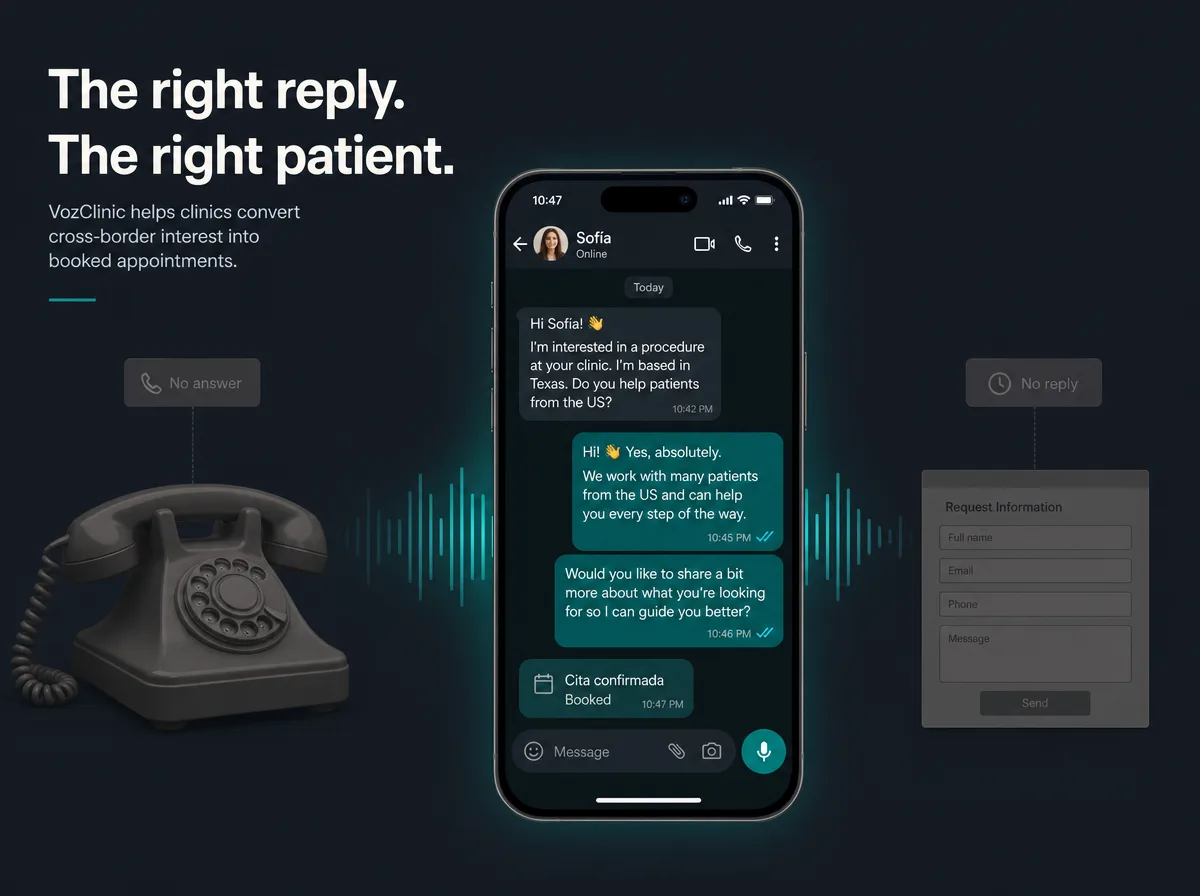
Ask any clinic in Tijuana where the patients actually are, and the answer is not the phone and it is not the contact form on the website. It is WhatsApp. The first message from a San Diego patient asking about a crown, the photo of an insurance card, the "are you open Saturday" at ten at night, the confirmation of tomorrow's appointment, all of it happens in one green app. In Mexico and along the border, WhatsApp is not a channel you add. It is the channel your patients already live in.
That single fact changes how a clinic should think about answering. This post is about why WhatsApp is the right home for your front desk, and what it means to put a bilingual AI receptionist there instead of hoping a person can keep up.
In Mexico, WhatsApp is the phone
For most of the people your clinic serves, WhatsApp has quietly replaced the phone call, the text message, and the email all at once. Families coordinate on it. Businesses run on it. A patient who would never leave a voicemail will fire off a WhatsApp message without a second thought, because that is simply how they talk to everyone. When your clinic asks that same patient to call during business hours or fill out a form, you are asking them to leave the place they are comfortable and do something they would rather not do.
Cross-border patients are no different. A patient in San Diego or Phoenix planning a trip to Tijuana treats WhatsApp as the natural way to reach a Mexican clinic, because they know that is where they will get an answer. Meeting them there is not a nicety. It is the difference between being reachable and being skipped.
The channel already fits how cross-border patients decide
A medical tourism decision is not made in one call. It is made over days of back-and-forth: a question about price, a follow-up about the procedure, a request for cross-border directions, a check on availability, a nervous last question the night before. WhatsApp is built for exactly that rhythm. The conversation stays in one thread, the patient can pick it up whenever they think of something, and nothing gets lost between a missed call and a callback that never happens.
A phone line cannot hold that thread. A web form cannot answer back. WhatsApp keeps the whole decision in one place, which is why the patients who are comparing your clinic against three others tend to book with the one that stayed in the conversation.
Why a phone line and a web form both leak
The phone has an obvious limit: someone has to pick it up. After hours, during a procedure, in the middle of a busy afternoon, the call rings out and the patient moves on. And a phone call in the wrong language stalls before it starts. The web form has a quieter limit: it is a one-way drop box. The patient types a question into a void, gets an auto-reply promising someone will be in touch, and waits. By the time your team works through the inbox, the patient has already messaged the next clinic on WhatsApp and gotten a reply.
Both channels lose for the same underlying reason. They depend on a person being available at the exact moment the patient reaches out, in the exact language the patient speaks. WhatsApp does not fix that by itself, a human still has to answer, but it is the channel where answering instantly actually matters, because it is where the patient is waiting for the reply.
What changes when the receptionist lives on WhatsApp
Putting a bilingual AI receptionist on WhatsApp is what turns the channel from a place patients message into a place they get answered. VozClinic runs on the official WhatsApp Business API using your clinic's existing number, so nothing changes for the patient except that now they always get a fast reply. Sofía answers in English or Spanish, in seconds, at any hour. She answers the price and preparation questions, books the appointment straight into your calendar, sends cross-border directions, and confirms with the reminders that keep the slot from turning into a no-show.
Because it is the official Business API and your own number, this is not a second line patients have to learn or a bot bolted onto a different app. It is your clinic's WhatsApp, finally answering the way patients expected it to all along. When a question falls outside the script or someone needs a human, it escalates to your team in seconds, and everything stays compliant with Mexico's data protection law, the LFPDPPP.
One channel, without one channel's limits
The honest catch with betting on WhatsApp is that some patients still prefer to call, and some conversations start somewhere else. That is why the same VozClinic receptionist that lives on WhatsApp also answers phone calls in both languages, and can work over SMS and Telegram when a clinic wants them. WhatsApp is the front door because that is where your patients are, but it is not a wall. The patient who calls instead of messaging gets the same receptionist, the same answers, the same booking, so you are meeting people where they are without splitting your front desk across a half-dozen disconnected inboxes.
Where WhatsApp fits with everything else the receptionist does
The channel is the foundation, and the work sits on top of it. The same receptionist that makes WhatsApp answer instantly is the one that catches your missed and after-hours calls and runs insurance verification and intake before the appointment, all in the same thread, on the same number. For the full picture of how it fits together, see the pillar overview of the bilingual voice agent for Tijuana medical tourism clinics.
Book a demo
Book a 20-minute call and we'll show you Sofía handling your clinic's real cases, in Spanish and English.
Questions? Email us at hola@vozclinic.com.
← Back to the blog