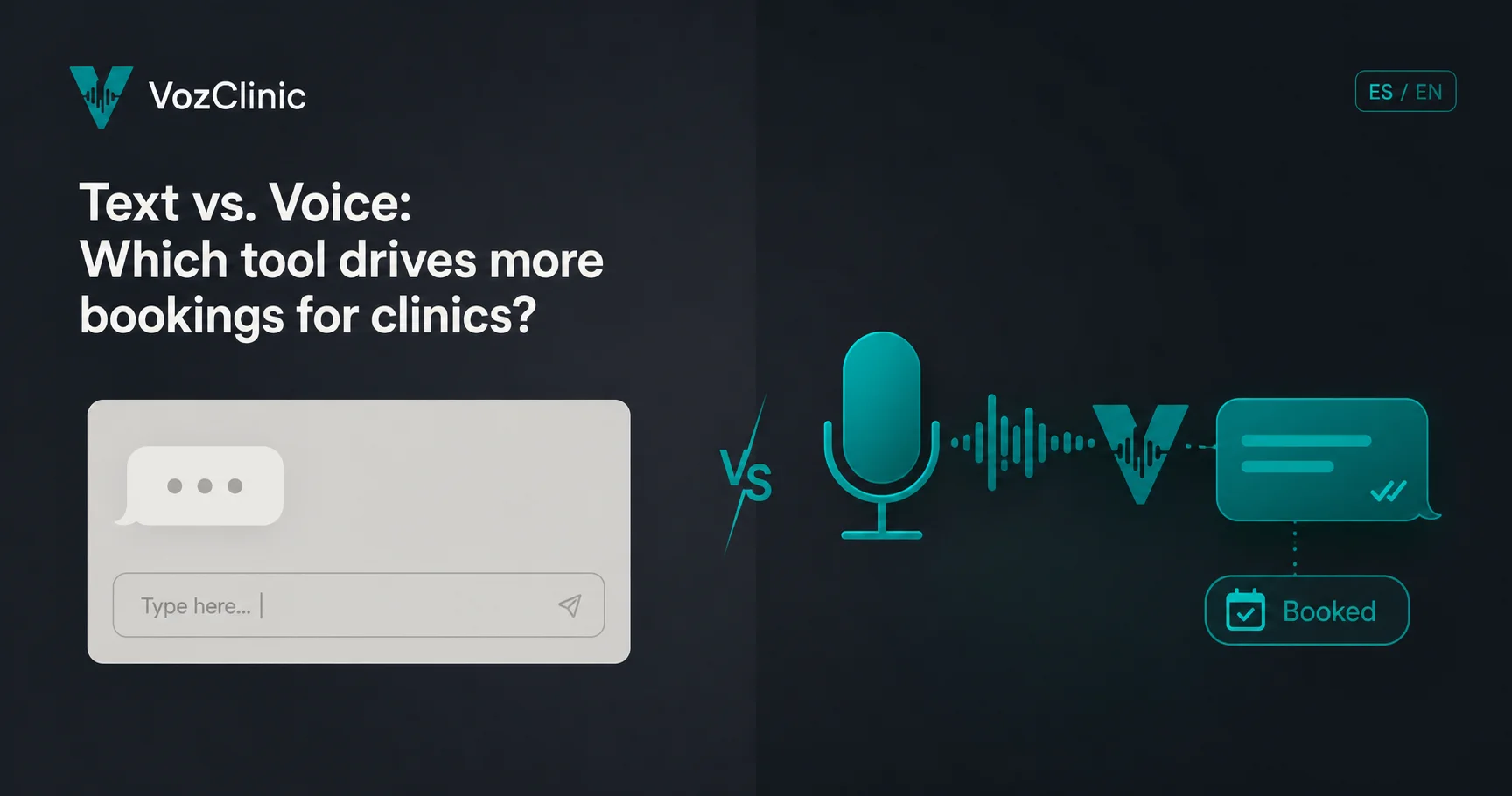
If you have been shopping for a way to stop losing after-hours patients, you have probably run into two very different-sounding products that both promise to "answer your patients automatically." One is a chatbot. The other is an AI voice agent. They get talked about as if they were the same thing, and they are not. Picking the wrong one for a bilingual, cross-border clinic is an easy and expensive mistake, so this post lays out the honest difference and where each one actually helps.
No hype, no pretending one option has no downsides. Just what a chatbot is good at, what a voice agent is good at, and why for a Tijuana clinic serving patients from both sides of the border, the answer leans hard toward voice and toward a bilingual foundation rather than a translated one.
The plain difference between the two
A chatbot is a typing tool. The patient types a message, the bot types back, and the whole exchange happens in text on a screen. Most clinic chatbots live in a little bubble on your website. Some are smart and conversational, many are still the old "click one of these buttons" kind, but either way the patient has to be at a keyboard, willing to type, and patient enough to wait for the thread to move.
An AI voice agent talks. The patient speaks a normal sentence out loud and hears a natural answer back in a couple of seconds, the way they would with a receptionist. A good voice agent is not limited to the phone, either. The same agent can hold a spoken conversation on a call, answer by voice or text on WhatsApp, and sit embedded on your website so a patient can book by talking instead of filling out a form. That flexibility is the first place the two diverge: a chatbot does one thing in one box, while a voice agent meets the patient on whatever channel they already use.
Where a chatbot genuinely does fine
It would be dishonest to pretend a chatbot has no place. For simple, text-first tasks it works. If a patient is already on your website during business hours, comfortable typing, and just wants to check your address or your Saturday hours, a chatbot answers that cleanly and cheaply. For a clinic whose patients are all local, all one language, and all happy to type, a decent chatbot covers a lot of the easy questions and takes some load off the desk.
So the question is not "are chatbots useless." They are not. The question is whether a text box on your website matches how your actual patients reach out, at the hours they reach out, in the languages they use. For a lot of clinics, and especially a medical tourism clinic, it does not, and that gap is where a voice agent pulls ahead.
Why voice fits a clinic patient better
Think about when and how your patients actually contact you. It is often late, often from a phone, often while they are anxious about a procedure or juggling a cross-border trip. In that moment, typing a careful message into a website widget is friction. Talking is not. People say more, and say it more naturally, out loud than they will type, which means a voice agent gets the full question ("do you have anything Saturday morning, do you take my insurance, and how do I cross at San Ysidro") in one breath instead of a stilted back-and-forth.
Voice also clears the barriers that quietly cost you bookings. A nervous patient, an older patient, a patient driving, or a patient whose typing in their second language is slow, all of them move faster by speaking. And speed is not a nice-to-have in this market. Your live site already makes the point: when nobody answers the 11 p.m. message, the patient contacts the next clinic on their list. A voice agent answers in seconds, on the channel the patient is already holding, which is exactly where a website-only chatbot cannot reach.
The bilingual line is where it gets decisive
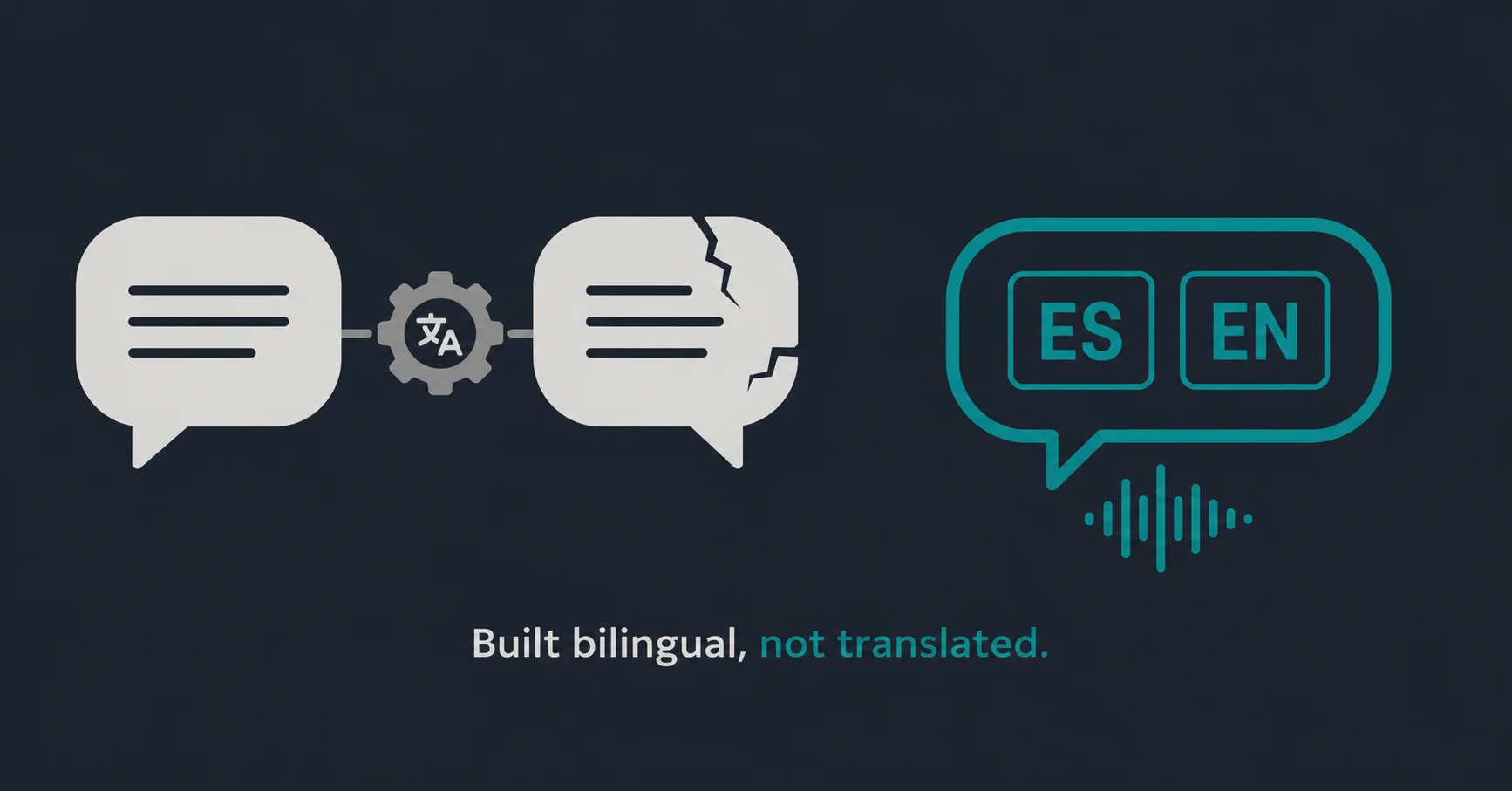
Here is the part that matters most for a Tijuana clinic, and it is not really about voice versus text at all. It is about how the two languages are handled underneath. More than 70 percent of medical tourism patients in Mexico come from the United States, so a large share of the people contacting you will open in English or slide between English and Spanish mid-conversation. The real question to ask any vendor is whether the tool holds a genuine conversation in each language, or whether it is quietly running your Spanish through machine translation to fake English.
This is the exact objection clinic owners raise, and it is the right one. A translated chatbot produces the stiff, slightly-off English that a San Diego or Phoenix patient notices in one line, and it does not know the border-crossing details they actually ask about. VozClinic's answer to "does it speak real English or is it Google Translate" is that Sofía speaks natural English, tested with real patients from San Diego, Los Angeles, and Phoenix, because bilingual is built into the foundation rather than bolted on with a translation layer. In this market, an agent that only works smoothly in one language is doing half the job, whichever format it comes in.
What it looks like when a patient uses each
Picture the same patient, a woman in Los Angeles, finding your clinic at 10 p.m. With a typical website chatbot, she has to be on your site, click into the widget, type her question, wait, type again to pick a time, and hope it actually books rather than just collecting her info for someone to follow up tomorrow. Plenty of patients bail somewhere in that thread, and if the English reads like translation, she quietly doubts the clinic before she even books.
With a voice agent, she opens WhatsApp, which she already has, and simply asks. Sofía answers in seconds in fluent English, confirms the service and the price your clinic set, checks real availability, offers two times, books the one she picks straight into your calendar, and adds the San Ysidro crossing and reminder details, all before your team is awake. The same Sofía does this by phone and embedded on your website too. And she knows her limits: an emergency, a complaint, or anything off-script escalates to your team in seconds instead of a guessed answer, with data handling that complies with the LFPDPPP.
So which should your clinic choose
If your patients are local, single-language, and content to type during business hours, a good chatbot may be enough, and there is no shame in starting there. But if you serve cross-border patients, run in two languages, and lose the most bookings after hours and on the phone, a bilingual AI voice agent is not a fancier chatbot, it is a different and better fit for the job you actually have. The honest summary: chatbots win on cheap-and-simple text tasks, voice agents win on how real clinic patients actually reach out, and for a bilingual Tijuana clinic the bilingual foundation is what tips it.
For the plain-language walk-through of how the voice side works, read voice AI for clinics, explained, and for the specific things the two-language handling unlocks, see 6 things a bilingual agent does that a translated chatbot cannot. For the full picture of everything the agent handles, start with the guide to AI for medical clinics.
Book a demo
Book a 20-minute call and we'll show you Sofía handling your clinic's real cases, in Spanish and English.
Questions? Email us at hola@vozclinic.com.
← Back to the blog