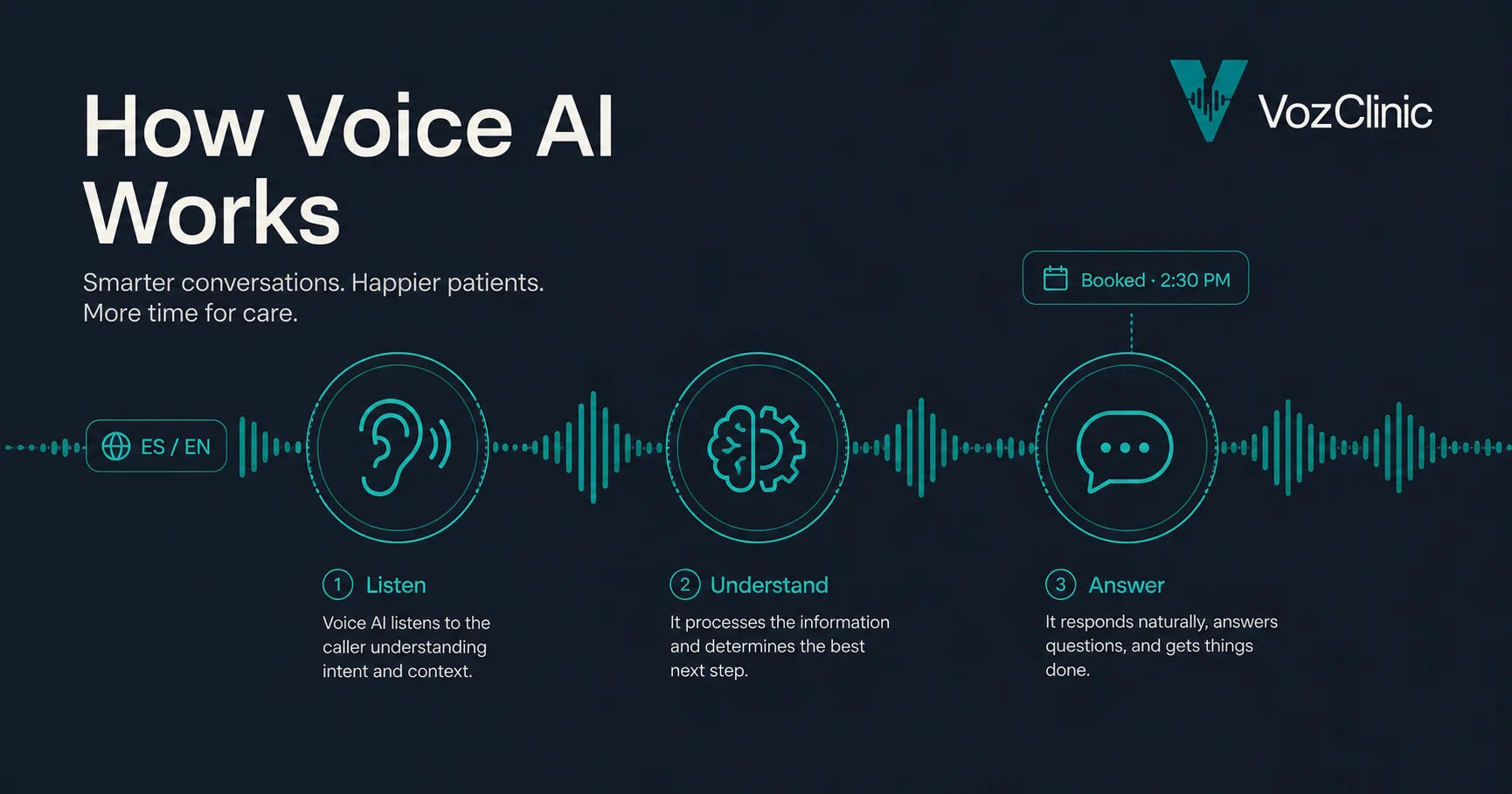
You have probably heard "voice AI" enough times this year to be a little tired of it, and still not have a clear picture of what it actually is or what it would do inside your clinic. That is fair. Most of what gets written about it is either a sales pitch or an engineering paper, and neither one tells a clinic owner the thing they want to know: when a patient talks to this, what happens, and can I trust it with my front desk.
This post is the plain-language version. No jargon you have to decode, no promises about the future. Just what voice AI for clinics is, how it works when a real patient reaches out, and where it fits next to the phone and WhatsApp you already use.
What voice AI actually is
Voice AI is software that can hold a spoken conversation. A patient talks to it the way they would talk to a person, and it understands what they said, figures out a useful answer, and says that answer back out loud, all in a couple of seconds. That is the whole idea. It is not a recording, and it is not the "press 1 for appointments" phone menu you already hate. It is a system that listens to a real sentence, in plain speech, and responds to what the patient actually meant.
The important word is conversation. An old phone tree makes the patient bend to the machine: say the exact keyword, pick from the exact menu, or start over. Voice AI works the other way around. The patient says "do you have anything Saturday morning, and how much is a cleaning," in whatever words come naturally, and the system handles both parts of that the way a good receptionist would. For a clinic, that difference is everything, because your patients are nervous, in a hurry, or speaking their second language, and none of them want to fight a menu.
How it works, in three steps
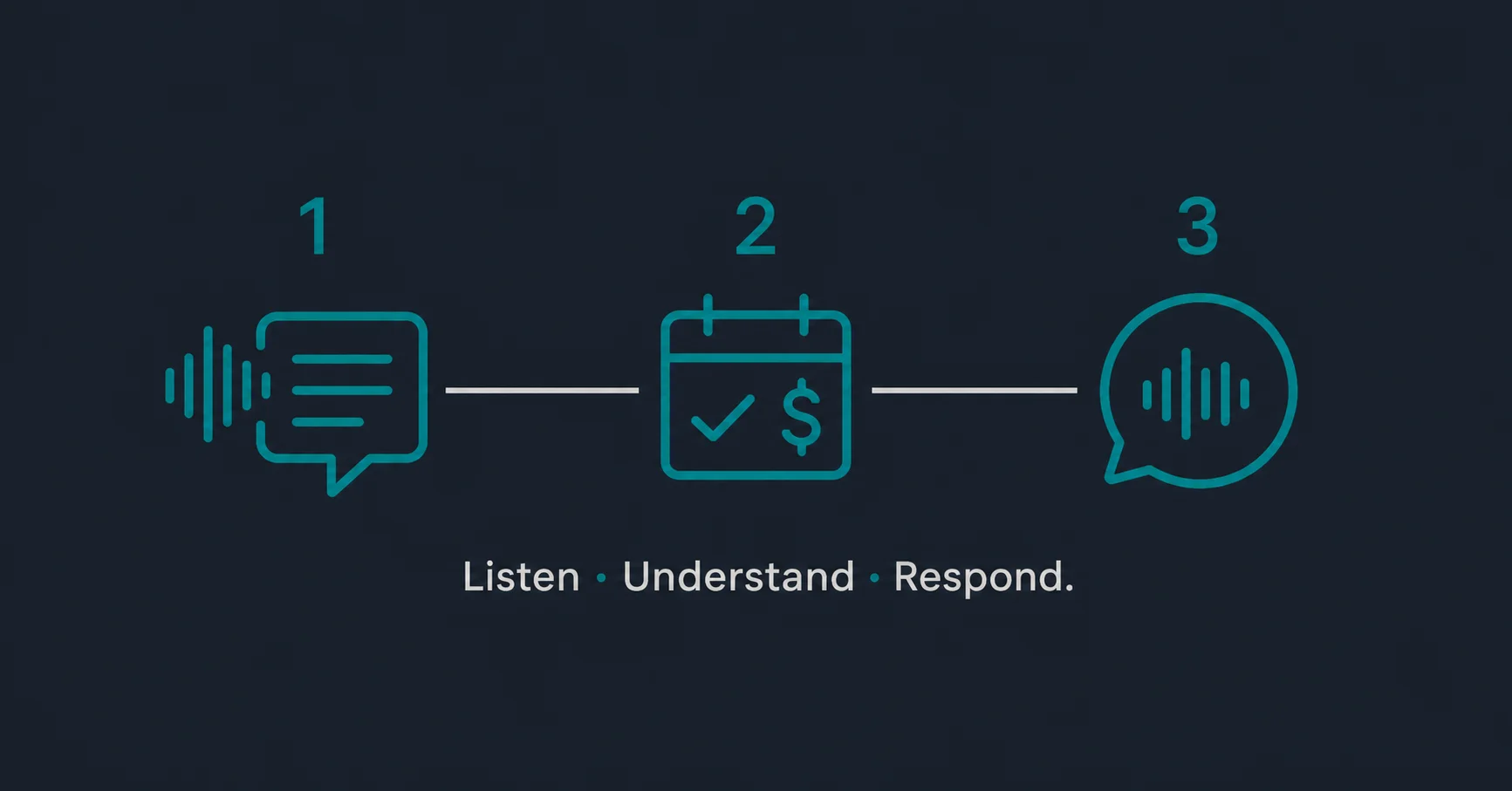
Under the hood there are three simple moves, and you do not need the technical names to understand them. First, the system listens and turns the patient's speech into text, the same way the dictation on your phone does, just more accurately across accents and both languages. Second, it reads that text and decides what the patient needs, checking it against what your clinic taught it: your prices, your services, your hours, your real calendar. Third, it speaks the answer back in a natural voice, and if the patient keeps talking, it keeps up.
That loop, listen, understand, respond, repeats for the length of the conversation, fast enough that it feels like talking to a person rather than waiting on a computer. The part that matters for your clinic is the middle step. A good voice agent is not making things up. It is answering from the facts you gave it during setup, which is why it can quote your actual prices and book into your actual calendar instead of guessing. When a question falls outside what it knows, it does not invent an answer. It hands the conversation to your team.
Why "bilingual" is not a feature, it is the point
For a Tijuana clinic, the single most useful thing about voice AI is that one agent handles English and Spanish equally well, and can switch mid-sentence when a patient does. More than 70 percent of medical tourism patients in Mexico come from the United States, so a large share of the people reaching your clinic will open in English or slide between the two languages without warning. A human front desk usually solves this with one bilingual staff member who becomes a bottleneck the moment they step away.
Voice AI removes that bottleneck because the language is built in, not bolted on. It is not translating your Spanish answers into clumsy English on the fly. It holds a real conversation in each language, with the border-crossing details a San Diego or Phoenix patient actually asks about. That is why we treat bilingual as the foundation of the product rather than a checkbox on a feature list. In this market, an agent that only works smoothly in one language is only doing half the job.
What it looks like when a patient uses it
Here is the concrete version. A patient in Los Angeles finds your clinic at 10 p.m., taps the button, and says, in English, that they want a consultation next week and need to know if you take their insurance. VozClinic's agent, Sofía, answers in seconds. She confirms the services, gives the price your clinic set, checks real availability, offers two times, and books the one the patient picks straight into your calendar. She schedules the reminders, adds the border-crossing and parking details for a cross-border patient, and the patient goes to bed with a confirmed appointment. Nobody on your team was awake.
The same Sofía does this on WhatsApp, on a phone call, and embedded on your website, so it does not matter which door the patient walks through. And she knows her limits. An emergency, a complaint, or a question outside the script goes straight to your team in seconds instead of getting a guessed answer. Everything stays compliant with Mexico's data protection law, the LFPDPPP, with auditable logs behind it.
What voice AI is not
It helps to be clear about the boundaries, because the hype blurs them. Voice AI is not a doctor and does not give medical advice, diagnoses, or clinical promises. It is not a magic box you plug in cold, either. It is only as good as the clinic behind it, which is why setup matters: VozClinic connects to your existing WhatsApp number in about 48 hours and learns your clinic in a single 90-minute training session covering your prices, services, doctors, hours, and the questions you answer fifty times a day.
And it is not here to replace your front desk. It is there to take the repetitive, after-hours, and bilingual load off your team so the people you employ can spend their attention on the patients in the chair. The routine questions and the midnight bookings go to the agent. The judgment, the care, and the complicated cases stay with your staff. That division is the point, not a compromise.
Where voice AI fits in your clinic
Think of voice AI as one front desk that never closes and answers on every channel at once. To see it doing the most common job, read how a website voice booking agent lets patients book by talking with no form, and for the cost of not having it, see the signs your clinic is losing patients to slow response times. For the full picture of everything the agent handles across your clinic, start with the guide to AI for medical clinics.
Book a demo
Book a 20-minute call and we'll show you Sofía handling your clinic's real cases, in Spanish and English.
Questions? Email us at hola@vozclinic.com.
← Back to the blog