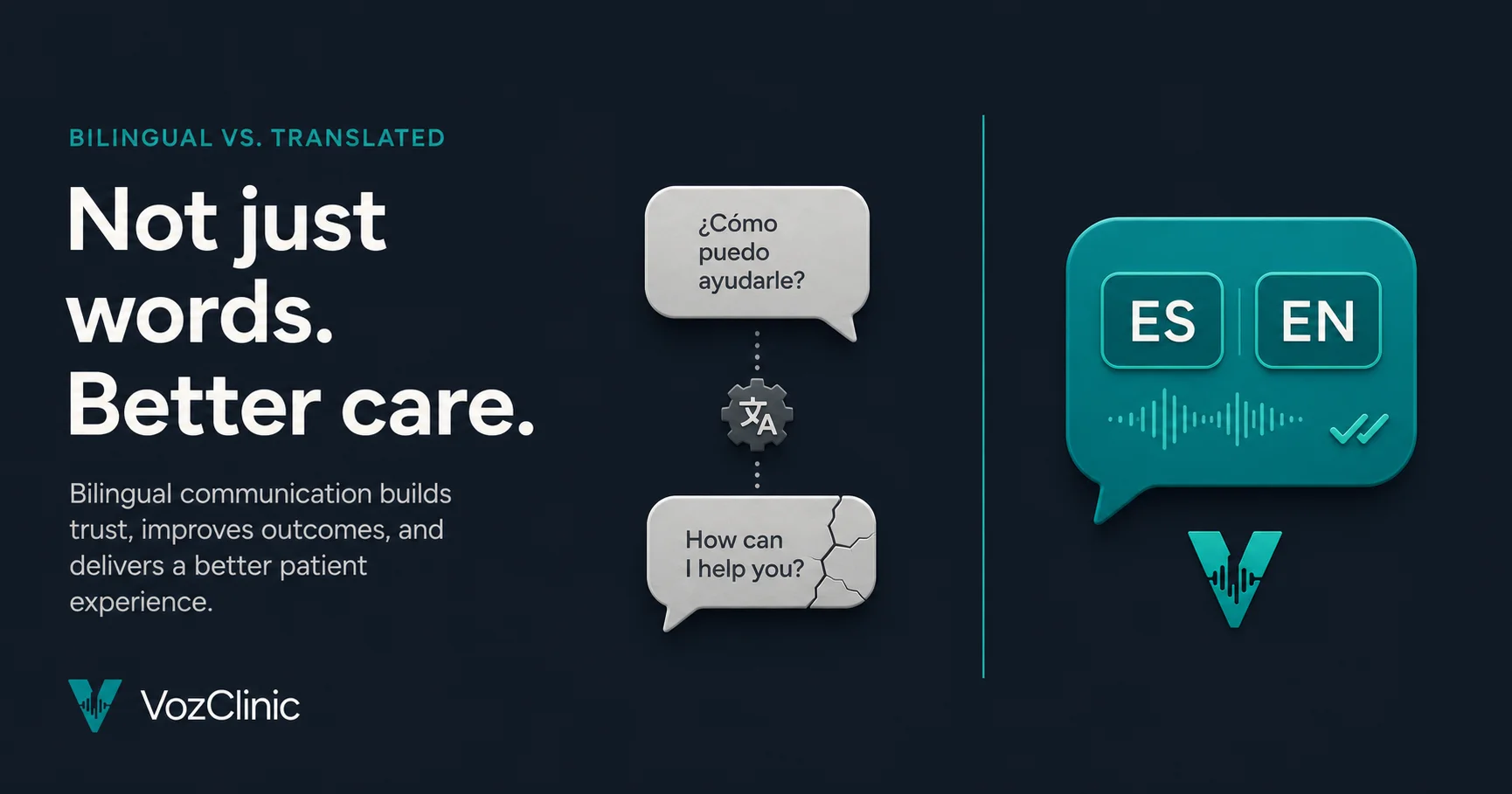
Plenty of tools claim to be "bilingual." Most of them are not. They are a Spanish bot with a translation layer stapled on, quietly running your answers through machine translation to produce English. It works well enough in a demo and falls apart with a real patient, which is a problem when more than 70 percent of medical tourism patients in Mexico come from the United States and can tell the difference in one line.
A truly bilingual agent is built in both languages from the start, not translated on the fly. That foundation is not a marketing detail, it changes what the tool can actually do for your clinic. Here are six things a genuinely bilingual AI voice agent does that a translated chatbot cannot.
1. Sound like a real person in English, not a translation
The fastest way a patient loses trust is stiff, slightly-off English that reads like a machine wrote it. A translated chatbot produces exactly that, because it is not composing in English, it is converting Spanish word by word. A bilingual agent speaks natural English tested with real patients from San Diego, Los Angeles, and Phoenix, so a U.S. patient hears a clinic that clearly serves people like them. That first impression is often the whole difference between a booking and a bounce.
2. Switch languages mid-conversation without breaking
Real cross-border patients do not stay in one language. They open in English, drop a Spanish phrase, ask a follow-up in whichever comes first. A translated chatbot treats each language as a separate mode and stumbles at the seam, sometimes answering in the wrong one. A bilingual agent follows the patient and switches mid-sentence the way a good bilingual receptionist does, so the conversation never stalls while the tool figures out which language it is supposed to be in.
3. Handle the border-crossing details that only exist in this market
Machine translation can turn "we take walk-ins" into Spanish, but it does not know what a Chula Vista patient means when they ask about the SENTRI lane, the San Ysidro wait, or where to park on the U.S. side. Those details are specific to cross-border care and simply are not in a generic translated bot. A bilingual agent built for Tijuana medical tourism knows them because your clinic taught it, and it answers the crossing question as smoothly as it answers the price question.
4. Use the right medical and payment words in each language
"Deductible," "out-of-pocket," "superbill," "limpieza," "presupuesto," "cita de valoración." Health and money vocabulary is exactly where translation goes wrong, producing terms that are technically a translation but not what a patient or a clinic actually says. A bilingual agent uses the real term in each language, so a U.S. patient asking about their deductible and a local patient asking about su presupuesto both get an answer that sounds like it came from a clinic, not a dictionary.
5. Answer instantly by voice in both languages, not just type
A translated chatbot is stuck in a text box, and translation adds even more lag while it converts each turn. A bilingual voice agent talks, in English or Spanish, and answers in seconds on WhatsApp, on a phone call, and embedded on your website. For a patient who is nervous, driving, or slow to type in their second language, hearing a natural answer out loud in their own language is the difference between finishing the booking and giving up on the thread.
6. Escalate cleanly in the patient's language, without garbling the handoff
When a question goes beyond the script, an emergency, a complaint, a genuinely complex case, the handoff to your team has to be clean. A translated chatbot can mangle that exact moment, passing along a garbled summary or dropping the thread between languages. A bilingual agent knows its limits and escalates to your staff in seconds with the context intact and in the right language, and it never invents a price, a diagnosis, or a promise to cover the gap. Data handling complies with the LFPDPPP the whole way through.
The thread through all six
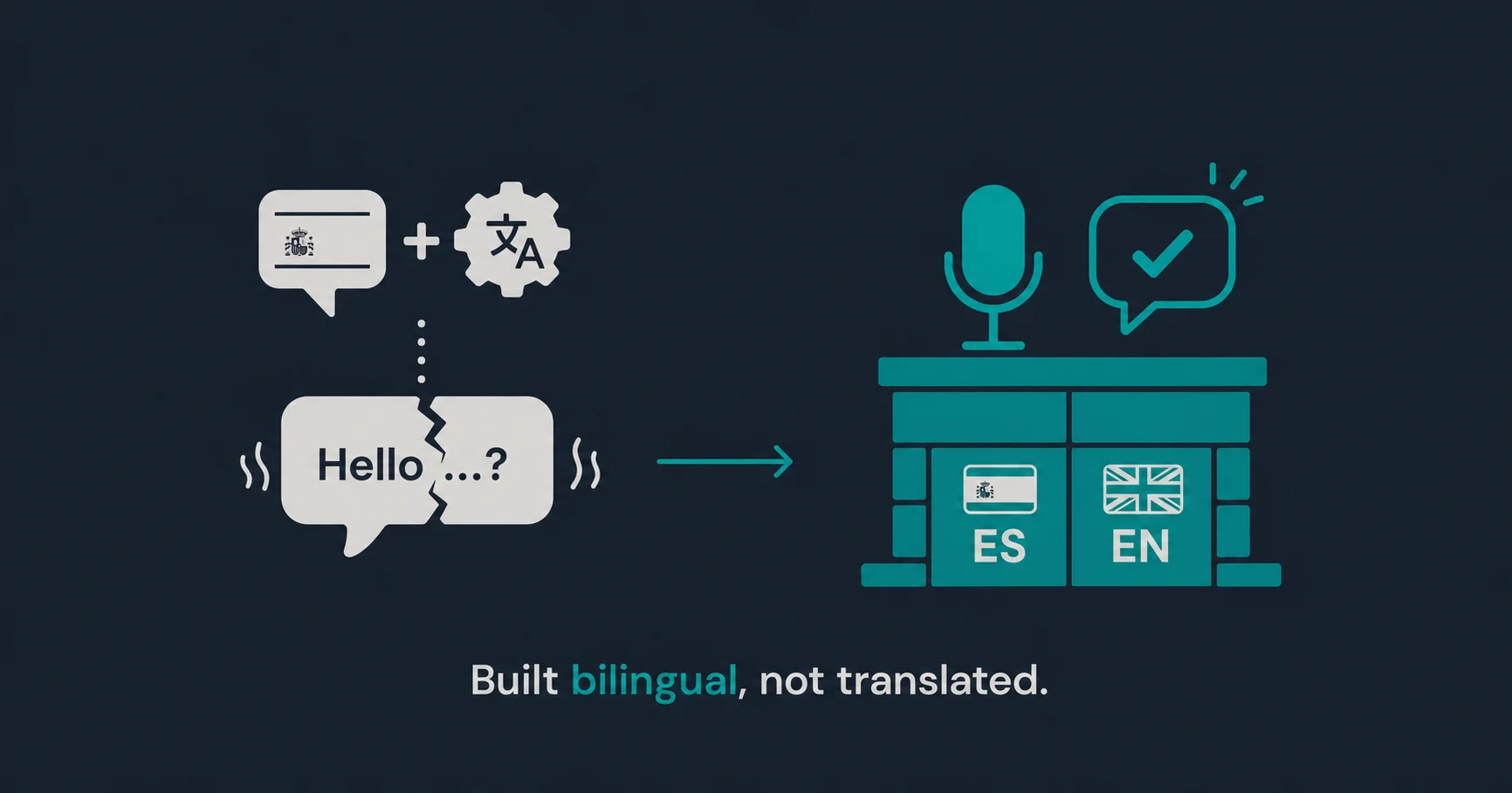
Every one of these comes back to the same root: bilingual has to be the foundation, not a translation layer bolted onto a Spanish bot. Translation can fake it in a demo, but a real patient in two languages, asking about their coverage at 11 p.m. from the U.S. side of the border, is where the difference shows. That is the exact objection smart clinic owners raise, "does it speak real English or is it Google Translate," and it is the right question to ask any vendor before you sign.
For the bigger comparison of formats, read AI voice agent vs chatbot for clinics, and for the plain-language version of how the voice side works, see voice AI for clinics, explained. For the full picture of everything the agent handles, start with the guide to AI for medical clinics.
Book a demo
Book a 20-minute call and we'll show you Sofía handling your clinic's real cases, in Spanish and English.
Questions? Email us at hola@vozclinic.com.
← Back to the blog