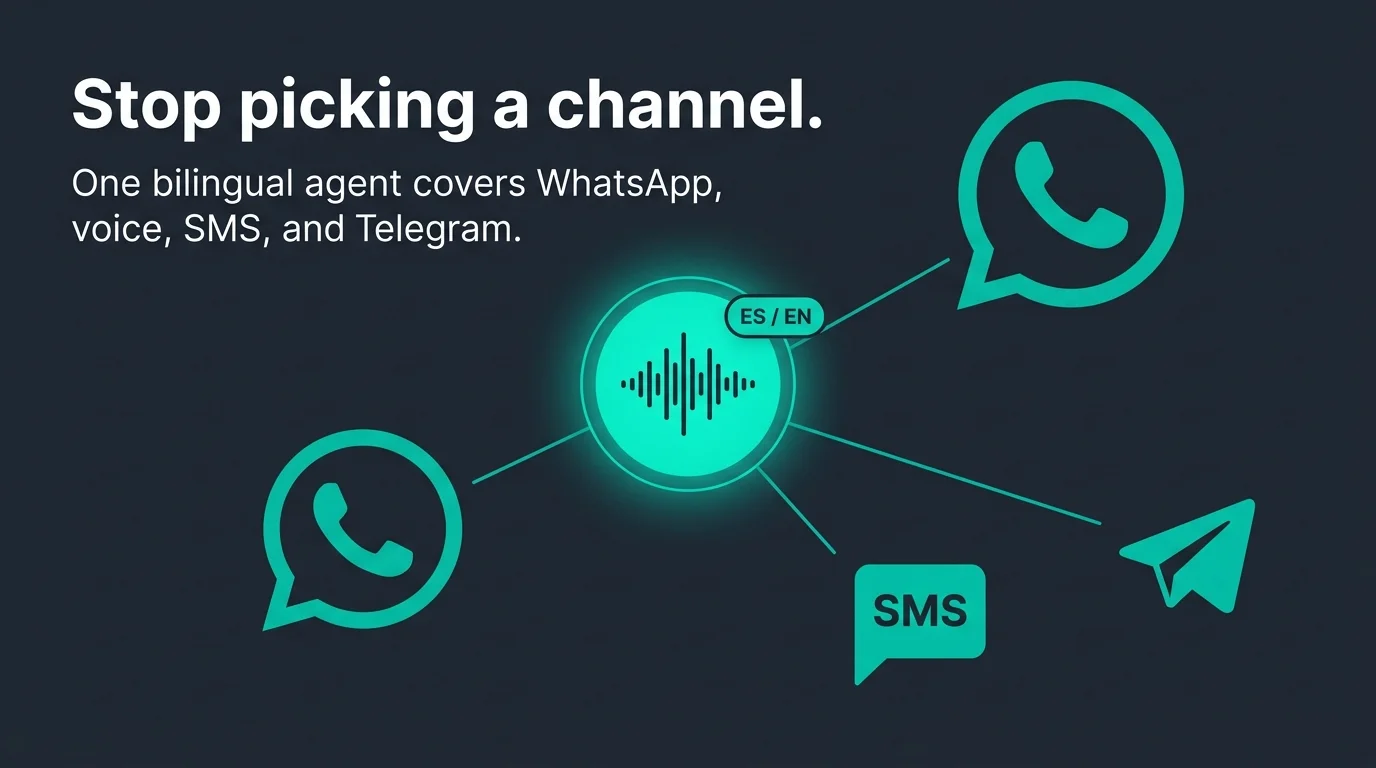
Most advice about clinic communication channels assumes you have to pick one. Go all-in on WhatsApp, or answer the phones better, or bolt a chat widget onto your website. For a bilingual clinic serving cross-border patients, that framing is the trap. Your patients do not all reach out the same way. The retiree in Phoenix calls. The younger patient in San Diego messages on WhatsApp at eleven at night. Someone lands on your website at lunch and wants to book without picking up the phone. Choosing one channel means being unreachable on the others, and being unreachable is exactly how a booked chair goes to the clinic down the street.
So the useful question is not which channel wins. It is what each channel is good for, where your patients actually are, and how you cover all of them without hiring a bigger front desk. Here is a plain guide to the four channels a Mexican and border clinic deals with, and how one bilingual AI voice agent can sit on all of them at once.
Short answer: For a bilingual clinic on the Mexican border, WhatsApp is the primary channel because it carries the most patient volume, phone calls still win high-intent callers, SMS is best for reminders and confirmations, and Telegram covers the patients the others miss. You do not have to choose one. A single bilingual AI voice agent can answer on all four, from your existing clinic number, in English and Spanish.
WhatsApp: the default for Mexico and the border
In this market, WhatsApp is not one channel among many. It is the channel. It is where your local patients already live, where cross-border patients from San Diego, Los Angeles, and Phoenix send their first message, and where a conversation can carry text, a voice note, a map to cross at San Ysidro, and an appointment confirmation without ever leaving the thread. If you only get one channel right, this is the one.
What makes WhatsApp work for a clinic is not just reach, it is trust and continuity. Patients recognize your number, the conversation history stays in one place, and the official WhatsApp Business API lets an agent answer on your existing clinic number so nothing changes for the patient. The catch is volume. WhatsApp invites patients to message any time, which is a gift right up until eleven at night when nobody is there to answer and the message sits unread until morning. That gap is the single biggest reason to automate this channel first, and it is why we wrote a fuller piece on why WhatsApp is the channel for Mexican and border clinics.
Voice calls: still how a lot of patients decide
Plenty of patients still call, especially older ones and especially for anything they consider serious or expensive. A phone call feels like proof there is a real clinic with a real person on the other end, and for a cross-border patient about to drive several hours for a procedure, that reassurance matters. The problem is that a phone call is the least forgiving channel of all. It has to be answered live, in the right language, right now. Miss it and there is no thread to come back to, just a voicemail the patient probably will not leave and you probably will not return in time.
This is where a bilingual clinic gets squeezed hardest. An English call comes in while your Spanish-speaking receptionist is with a patient, and it goes unanswered, and that caller was ready to book. Voice is not going away, so the answer is not to push everyone to text. It is to make sure the phone gets answered every time, in English or Spanish, without your front desk having to drop the patient in front of them to grab it.
SMS: narrow, but useful where it fits
SMS is the plainest channel, and its value is exactly that plainness. It reaches any phone without an app, it is nearly always read, and it is well suited to short, one-way, time-sensitive messages: an appointment reminder, a confirmation, a quick "we are running fifteen minutes behind." What SMS is not good at is conversation. It has no rich media, no easy back-and-forth, and it can feel impersonal for anything beyond a nudge.
For most clinics, SMS is a supporting channel, not a primary one. Use it when a patient does not use WhatsApp, or as a reliable backup for reminders and confirmations where you just need the message to land. It is worth having available so you are not locked out of reaching a patient who lives on plain text, but it should not carry the weight of your real patient conversations.
Telegram: worth having, rarely the main door
Telegram matters for a slice of patients, often more tech-forward or international ones, who prefer it or simply do not use WhatsApp. It handles rich conversation well and works across devices, so for the patients who are there it is a perfectly good place to talk. The honest read for a Tijuana or border clinic is that it will almost never be your primary channel. It is the channel you want covered so that the patient who prefers it is not met with silence, not the one you build your whole front desk around.
The principle here is the same one that runs through all four channels: you do not want to force patients onto the channel that happens to be convenient for you. You want to meet each patient where they already are, even if that is a smaller channel, because the patient who has to switch channels to reach you is the patient who reaches a competitor instead.
The real answer: cover them all with one agent
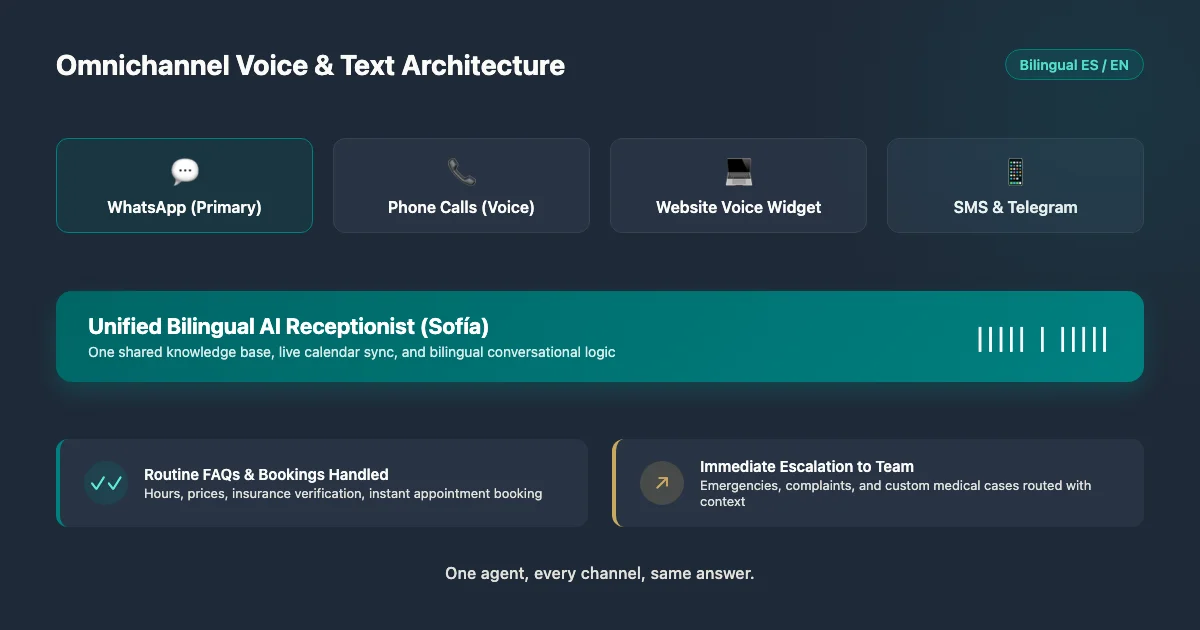
Look at the four channels together and the pattern is obvious. WhatsApp carries the volume, voice carries the high-intent callers, SMS backs up reminders, and Telegram catches the patients the others miss. No single channel covers your patients, and running four channels with human staff means four times the coverage problem, in two languages, around the clock. That math does not work for a clinic front desk.
This is the case for a bilingual AI voice agent, and it is where the channel question actually gets solved. Sofía answers on WhatsApp, picks up phone calls in English or Spanish, books through a widget embedded on your website, and can run on Telegram and SMS when your clinic wants them, all from your existing clinic number and all trained on your real prices, services, and hours during a 90-minute session. A patient gets the same fast, correct, bilingual answer whether they called, messaged, or clicked, and the routine questions resolve themselves while anything real, an emergency, a complaint, a complex case, escalates to your team in seconds. Patient data is handled under the LFPDPPP the whole time, with consent captured in the conversation and auditable logs, and every Monday you get a WhatsApp report of what came in across every channel and what it booked.
That is the shift. You stop choosing a channel and start covering your patients, which is what they were asking for in the first place. If you are still weighing whether voice or chat is the right foundation for that, the deeper comparison lives in AI voice agent vs chatbot for clinics, and for the full picture of everything the agent handles, start with the guide to AI for medical clinics.
Frequently asked questions
What is the best communication channel for a medical clinic?
For a bilingual clinic serving cross-border patients, WhatsApp is the best primary channel, because it is where the most patients already are and it carries text, voice notes, maps, and appointment confirmations in one thread. But no single channel reaches everyone, so the strongest setup covers WhatsApp, phone calls, SMS, and Telegram together rather than betting on one.
Can one AI voice agent handle WhatsApp, phone calls, and my website?
Yes. VozClinic's agent, Sofía, answers on WhatsApp, picks up phone calls, and books through a widget embedded on your website, and can also run on Telegram and SMS when your clinic wants them. It is one agent across every channel, so a patient gets the same fast, correct answer whether they messaged, called, or clicked.
Do I need to change my clinic's phone or WhatsApp number?
No. The agent runs on your existing clinic number through the official WhatsApp Business API, so nothing changes for your patients. They message or call the same number they always have and simply get answered right away.
Does it answer patients in both English and Spanish?
Yes. The agent is bilingual by design, identifies the patient's language, and switches between English and Spanish mid-conversation, so the English-speaking patient from San Diego and the local Spanish-speaking patient both get a natural answer on whichever channel they used. Its English was tested with real patients in San Diego, Los Angeles, and Phoenix, so it is not machine translation.
Does it book directly into my calendar?
Yes. It integrates with Google Calendar, Outlook, and Open Dental, checks real availability, and writes the appointment directly into your schedule instead of just collecting a name for someone to follow up on later.
How much does an AI receptionist for a clinic cost?
VozClinic starts at $299 USD per month for a single doctor and location, with higher tiers for multi-doctor practices and clinics that need automated insurance and claims. There are no long-term contracts, you keep your existing number, and promotions, insurance verification, and patient reactivation are optional add-ons on any plan. You can estimate what one recovered booking a week is worth to your clinic with the ROI calculator at www.vozclinic.com.
VozClinic is available now
VozClinic is live and open to clinics today. Book a 20-minute demo with Mateo and watch Sofía handle your clinic's real cases in English and Spanish, and if it fits you can start onboarding the same week, with most clinics answering live patients within about a week. Book your demo with Mateo and your first month is free.
Questions? Email us at hola@vozclinic.com and tell us which channels your patients use most. We will show you how one agent would cover them.
Stop picking a channel. Cover your patients. Book a demo with Mateo →
← Back to the blog