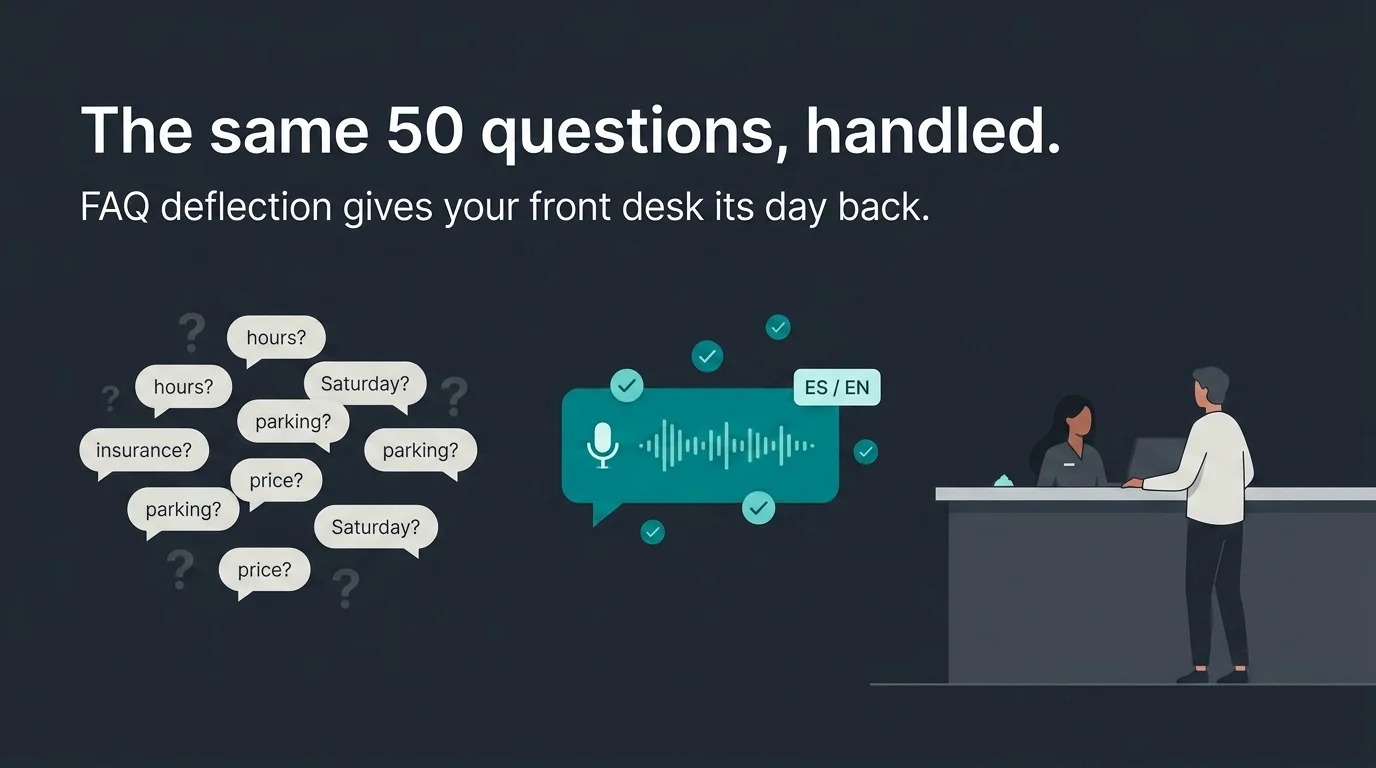
Count the questions your front desk answered today. Not the hard ones, the easy ones. What are your hours. Do you take my insurance. How much is a cleaning. Where do I park. How do I cross at San Ysidro. Are you open Saturday. Your team probably answered some version of those fifty times before lunch, in two languages, while a patient stood at the counter waiting and the phone rang and a WhatsApp message sat unread. That is the quiet tax on a clinic front desk, and clinic FAQ automation is how you stop paying it.
This is not about replacing your receptionist. It is about handing the repetitive, low-value questions to a bilingual AI voice agent so the person at your desk can do the part only a person can do, which is take care of the patient standing in front of them. Here is what FAQ deflection actually means for a clinic, where it helps most, and where it should hand back to a human.
What "FAQ deflection" really means
The term comes from support teams, and it is simpler than it sounds. Deflection just means a routine question gets answered correctly at the first point of contact, without a staff member having to stop what they are doing to handle it. The patient still gets a real answer, fast. Your team just does not have to be the one to type it or say it for the hundredth time.
For a clinic, the questions that deflect cleanly are the ones with a stable, factual answer that does not change from patient to patient: your hours, your address, parking, accepted insurance, the price your clinic set for a common service, what to bring, how to prepare for a procedure, and the border-crossing details a cross-border patient needs. Those are the exact questions that eat your front desk's day, and they are the easiest ones to answer perfectly every time when the answer comes from your own clinic's information.
The real cost of answering the same thing fifty times
The problem with repeat questions is not that any single one is hard. It is the volume and the interruption. Every time your receptionist stops to say "we open at nine" or "yes, we take that plan," they lose the thread on whatever they were doing, whether that was checking in a patient, following up on a treatment plan, or working the phone. Context switching all day is exhausting, and it is why good front-desk staff burn out answering questions a script could handle.
Your own clinic already feels this. The homepage says it plainly: your team is worn out answering the same questions in two languages, fifty times a day, while you pay for leads that slip away when nobody can get to them. The after-hours version is worse, because at eleven at night there is no receptionist to interrupt at all, so the question simply goes unanswered and the patient messages the next clinic on their list. FAQ deflection closes both gaps at once, the daytime interruption and the after-hours silence.
How a bilingual voice agent handles the repeat questions
A voice agent like Sofía answers those routine questions the moment they come in, in English or Spanish, on WhatsApp, on a phone call, or embedded on your website. It is not guessing. During a 90-minute training session your clinic teaches it your real prices, services, doctors, hours, and frequently asked questions, so every answer comes out in your clinic's voice with your clinic's facts. A patient in San Diego who asks about a cleaning price at ten at night gets the number you set, not a placeholder and not a promise for someone to call back tomorrow.
Because the agent is bilingual by design, it does this equally well for the English-speaking patient and the local Spanish-speaking one, and it switches between the two mid-conversation the way a good bilingual receptionist does. And because it lives on the channels your patients already use, the deflection happens where the question was asked, not in a widget the patient has to go find. The same repeat question that used to interrupt your desk now gets answered in seconds, correctly, and your team never has to touch it.
The line that keeps deflection safe: it hands back
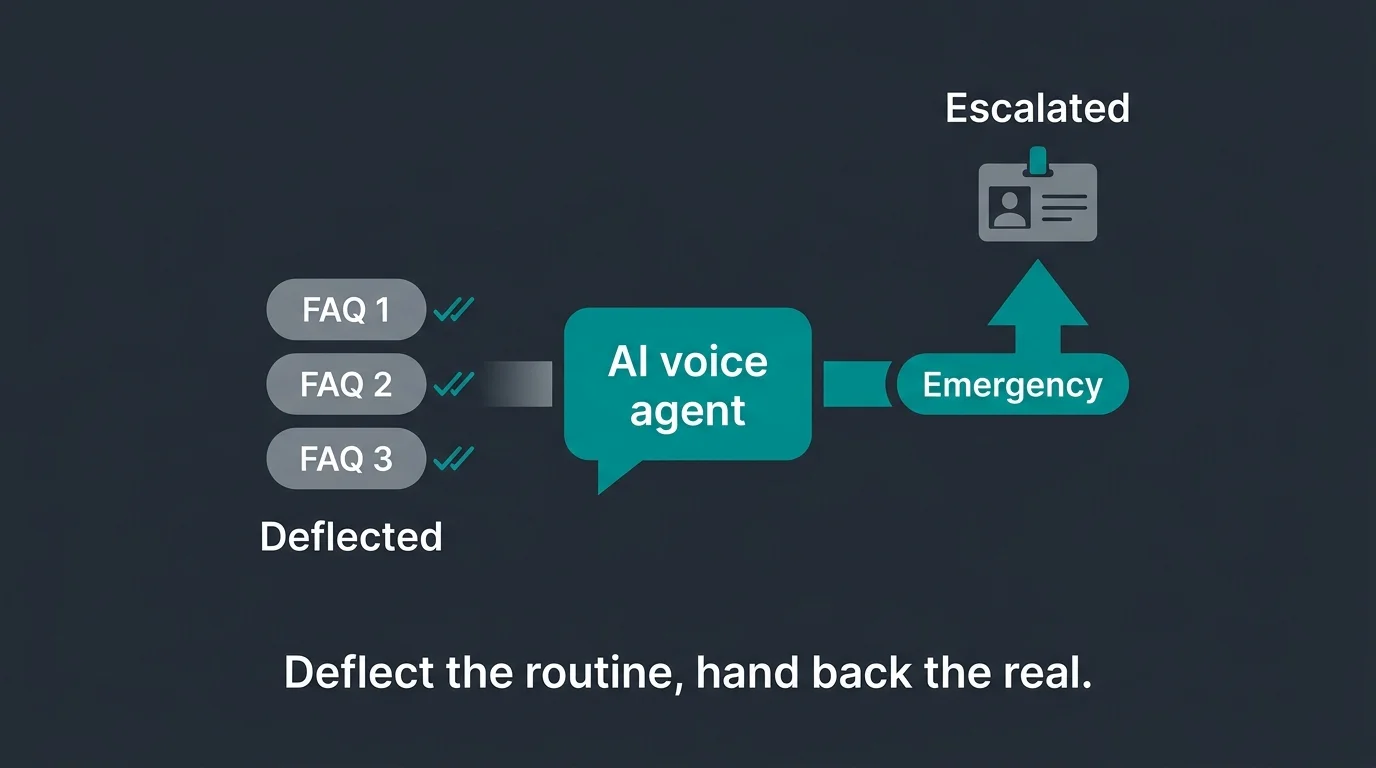
Deflection only works if the tool knows the difference between a routine question and a real one, and hands the real ones to a human immediately. This is where a lot of automation goes wrong, and it is worth being clear about. Sofía answers the stable, factual questions and escalates everything else to your team in seconds: an emergency, a complaint, a genuinely complex case, or anything outside the script. It never invents a price, a diagnosis, or a medical promise to fill a gap, which is the failure mode that makes clinic owners rightly nervous about automation.
That boundary is the whole point. FAQ deflection is not a wall between your patients and your staff. It is a filter that lets the fifty easy questions resolve themselves so the two questions that actually need a human reach your team faster and with the context already gathered. Your receptionist spends less of the day on autopilot and more of it on the patients and cases that need judgment, and data handling complies with the LFPDPPP the entire time.
What your front desk gets back
Add it up over a week. The interruptions that used to fracture your receptionist's attention are gone, the after-hours questions that used to vanish are answered, and the patients who reach a human are the ones who genuinely needed one. Your team is not doing less work, they are doing better work, the kind that keeps patients coming back and turns a first message into a booked chair. Every Monday you get a WhatsApp report showing what was handled, what was booked, and the revenue that came out of it, so the deflection is not a black box.
For a clinic serving cross-border patients in two languages, that shift is not a small convenience. It is the difference between a front desk that spends the day reacting and one that spends it caring for people, which is the reason the clinic exists in the first place.
Where to read next
For the full list of jobs the agent takes off your team, see 7 front-desk tasks a bilingual AI voice agent takes off your staff's plate, and for the plain-language explanation of how the voice side works under the hood, read voice AI for clinics, explained. For the complete picture of everything the agent handles, start with the guide to AI for medical clinics.
Book a demo
Book a 20-minute call and we'll show you Sofía handling your clinic's real cases, in Spanish and English.
Questions? Email us at hola@vozclinic.com.
← Back to the blog