Before a clinic owner in Tijuana lets anything answer a patient on their behalf, one question sits in front of all the others: is this legal with my patients' data? It is the right question to ask. An AI voice agent that handles bookings, insurance questions, and reminders is touching personal data the moment a patient types a name and a phone number, and in Mexico that data is governed by the Federal Law on the Protection of Personal Data Held by Private Parties, the LFPDPPP. A tool that speeds up your front desk but mishandles that data is not a time-saver, it is a liability waiting to surface.
The good news is that compliance here is not mysterious. The LFPDPPP asks for a short, concrete set of things: tell people what you are collecting and why, get their consent, keep the data secure, use it only for what you said, and let them exercise their rights over it. A well-built voice agent is designed around those requirements rather than bolted on after the fact. This post walks through exactly how a bilingual AI receptionist handles patient data, consent, and logging under the LFPDPPP, and where the clinic's own responsibilities still sit.
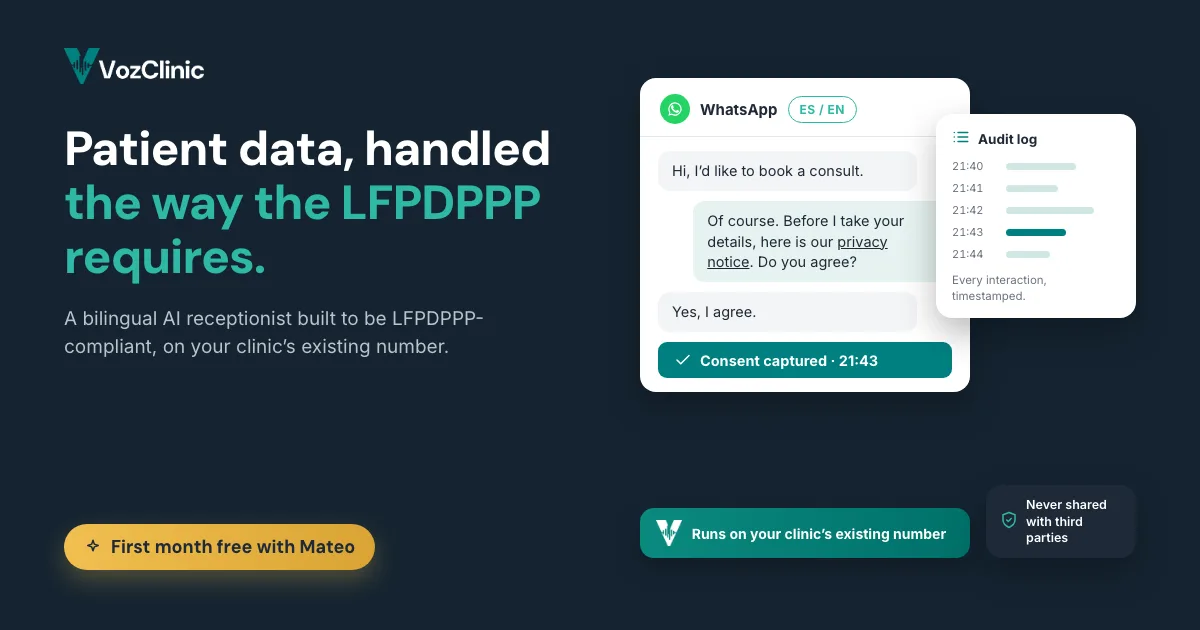
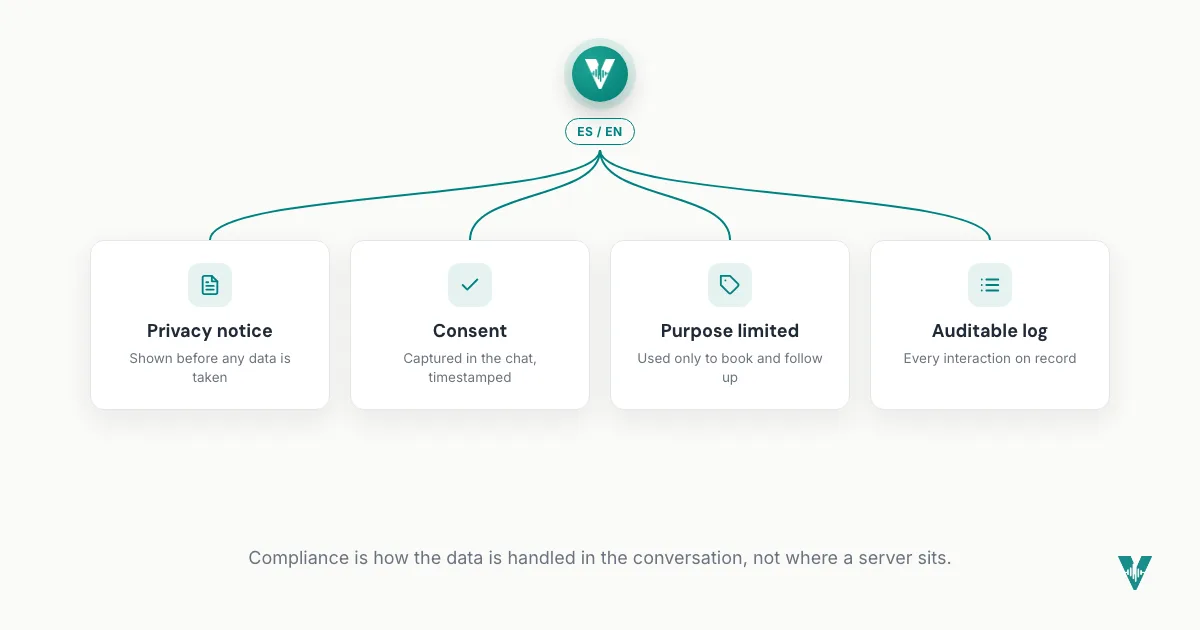
Short answer: Yes, an AI voice agent can be LFPDPPP-compliant, and VozClinic is built to be. It captures the patient's consent inside the conversation before handling their data, operates under your clinic's published privacy notice (aviso de privacidad), keeps an auditable log of every interaction, and never sells or shares patient data with third parties. It runs on the official WhatsApp Business API and keeps your clinic's existing number. Compliance is about how the data is handled, consent, notice, security, and the patient's rights, not about where a server physically sits.
Is an AI voice agent compliant with Mexico's patient data law?
It can be, and the compliance lives in the design, not in a certificate you hang on the wall. The LFPDPPP does not ban automation or AI. What it requires is that whoever handles personal data does so lawfully: with a privacy notice, with consent, with a clear purpose, with reasonable security, and with a way for the person to access, rectify, cancel, or object to the use of their data, the ARCO rights. An AI voice agent meets the law when it is configured to do each of those things, and falls short when it is a generic bot scraping conversations with no notice and no consent.
VozClinic is built for the first case. The agent, Sofia, is configured to capture consent in the conversation, to act under your clinic's privacy notice, and to log every exchange so there is an auditable record. The clinic remains the data controller, the responsable, which is as it should be, because the patients are your patients and the relationship is yours. The agent is the tool that carries out the data handling correctly on your behalf.
How does the agent capture patient consent?
Inside the conversation, before it does anything with the data. The LFPDPPP treats consent as the hinge of lawful processing, so the agent is designed to obtain it at the point of contact rather than assume it. When a new patient reaches out, Sofia presents the clinic's privacy notice and asks the patient to agree before their information is used to book, qualify, or follow up. The consent is captured in the same thread, in the patient's language, which means it is both clear to the patient and recorded for you.
This matters because consent given in a natural WhatsApp exchange is consent the patient actually understood, not a checkbox buried in a form nobody reads. It also means the record of that consent lives in the same log as the rest of the conversation, timestamped and attributable. If a patient later asks what they agreed to, or you need to show that consent was obtained, the evidence is already there.
What is a privacy notice, and does the agent need one?
The privacy notice, the aviso de privacidad, is the document that tells patients what personal data you collect, why, how it is used, and how they can exercise their rights over it. Under the LFPDPPP it is not optional, every responsible party that collects personal data must have one and make it available. Your clinic almost certainly already has one, and the voice agent operates under it rather than inventing its own.
In practice this means the agent points patients to your published notice at the moment of consent, and handles their data only within the purposes that notice describes. The agent does not quietly expand what you do with patient data. If your notice says you collect contact details to schedule and follow up on care, that is what the agent uses the data for. Keeping the agent inside the boundaries of your existing notice is part of what makes it compliant rather than a new, unaccounted-for way that data leaves your control.
What does "auditable logs" actually mean for a clinic?
It means every conversation the agent has is recorded, timestamped, and retrievable, so nothing the agent did with a patient's data is a black box. If you ever need to demonstrate that consent was captured, show what a patient was told, or trace how a piece of information was used, the log is the answer. This is both a compliance safeguard and a practical operations tool, because the same record that satisfies an audit also lets you review how patient conversations are being handled.
Auditable logging is also what separates a serious, compliant tool from a disposable chatbot. A generic bot that answers messages and forgets them leaves you unable to prove anything about how patient data was handled. A logged system gives the clinic, the data controller, a continuous, reviewable account of every interaction. When you are the responsable under the LFPDPPP, that paper trail is not bureaucracy, it is your protection.
Does the agent share or sell patient data?
No. VozClinic does not sell patient data and does not share it with third parties for their own use. The data a patient provides is used to do the clinic's work, booking, reminders, qualification, follow-up, under your privacy notice, and nothing more. This is a deliberate boundary, because the fastest way for an automated tool to turn into a compliance problem is to let patient data flow somewhere the patient never agreed to.
One clarification worth making, because clinic owners ask it often: compliance is about how data is handled, not about where a server physically lives. The LFPDPPP is concerned with consent, notice, purpose limitation, security, and the patient's ARCO rights. It does not require that data be stored inside Mexico, and VozClinic does not claim data residency as a compliance feature. What makes the handling lawful is the consent, the notice, the purpose discipline, and the auditable record, all of which travel with the data regardless of infrastructure. If a vendor tries to sell you "the data stays in Mexico" as the headline compliance promise, that is a sign they are selling you the wrong thing.
What about HIPAA and my US patients?
This is the honest part. HIPAA is a United States law, and VozClinic is built for clinics operating in Mexico under the LFPDPPP, which is the law that governs your clinic's handling of patient data. Having patients who travel from the US does not automatically place your clinic under HIPAA, but if your practice has specific obligations, through a US partner, a billing relationship, or your own legal counsel's reading of your situation, that is a conversation to have directly with the VozClinic team and your advisor rather than something to assume from a blog post. We will not claim a compliance posture the product does not have. What we will say plainly is what is true: the agent is built around LFPDPPP requirements, and we are straight with clinics about where a line sits.
Where the clinic's responsibility still sits
A compliant tool does not remove the clinic from the picture, and it should not pretend to. Your clinic is the data controller. You own the privacy notice, you decide the purposes, and you remain responsible for honoring patient rights. What the agent does is carry out the handling correctly, capturing consent, staying inside your notice, logging everything, and keeping data from leaking to third parties, so that the automation strengthens your compliance posture instead of quietly undermining it. Choosing a vendor that takes this seriously is itself part of doing right by your patients, which is exactly why we put it on the list of questions to ask any vendor before you sign.
Where to read next
Start with the hub, AI for medical clinics: what a bilingual voice agent actually does, for the full picture of what the agent handles. Then read 7 questions to ask any AI voice agent vendor before you sign, where compliance is one of the vetting criteria, and why WhatsApp is the channel for Mexican and border clinics, which covers the official WhatsApp Business API the agent runs on.
Frequently asked questions
Is an AI voice agent LFPDPPP-compliant?
It can be, and VozClinic is built to be. The LFPDPPP does not prohibit AI or automation; it requires a privacy notice, consent, purpose limitation, reasonable security, and respect for the patient's ARCO rights. An agent that captures consent in the conversation, operates under your clinic's privacy notice, logs every interaction, and does not share data with third parties meets those requirements. A generic bot with no notice and no consent does not.
How does the agent get patient consent?
It captures consent inside the conversation, before using the patient's data. When a new patient makes contact, the agent presents your clinic's privacy notice and asks the patient to agree, in their own language, and that consent is recorded in the same thread with a timestamp. This means the patient genuinely understood what they agreed to and the clinic has an auditable record of it.
Does my clinic still need a privacy notice?
Yes. The privacy notice, the aviso de privacidad, is required of every party that collects personal data under the LFPDPPP, and the agent operates under your clinic's existing notice rather than creating its own. The agent points patients to that notice at the point of consent and uses their data only for the purposes the notice describes.
Does VozClinic store patient data in Mexico?
Compliance under the LFPDPPP is about how data is handled, consent, notice, purpose, security, and the patient's rights, not about where a server physically sits. The law does not require data residency in Mexico, and VozClinic does not claim data residency as a compliance feature. What makes the handling lawful is the consent, the privacy notice, the purpose discipline, and the auditable log.
Does the agent sell or share patient data?
No. VozClinic does not sell patient data and does not share it with third parties for their own use. Patient data is used only to do the clinic's work, booking, reminders, qualification, and follow-up, under your privacy notice, and every interaction is logged so the handling is reviewable.
Is it HIPAA-compliant for my US patients?
HIPAA is a US law, and VozClinic is built for clinics operating in Mexico under the LFPDPPP. Having patients who travel from the US does not automatically put your clinic under HIPAA, but if your practice has specific US obligations, confirm them with the VozClinic team and your own legal advisor rather than assuming a compliance posture. We will not claim coverage the product does not have.
VozClinic is available now
VozClinic is available now. Book a 20-minute demo with Mateo and your clinic gets its first month free. See exactly how the agent captures consent, works under your privacy notice, and logs every conversation at www.vozclinic.com, or send your questions to hola@vozclinic.com. Hecho en Tijuana.
← Back to the blog