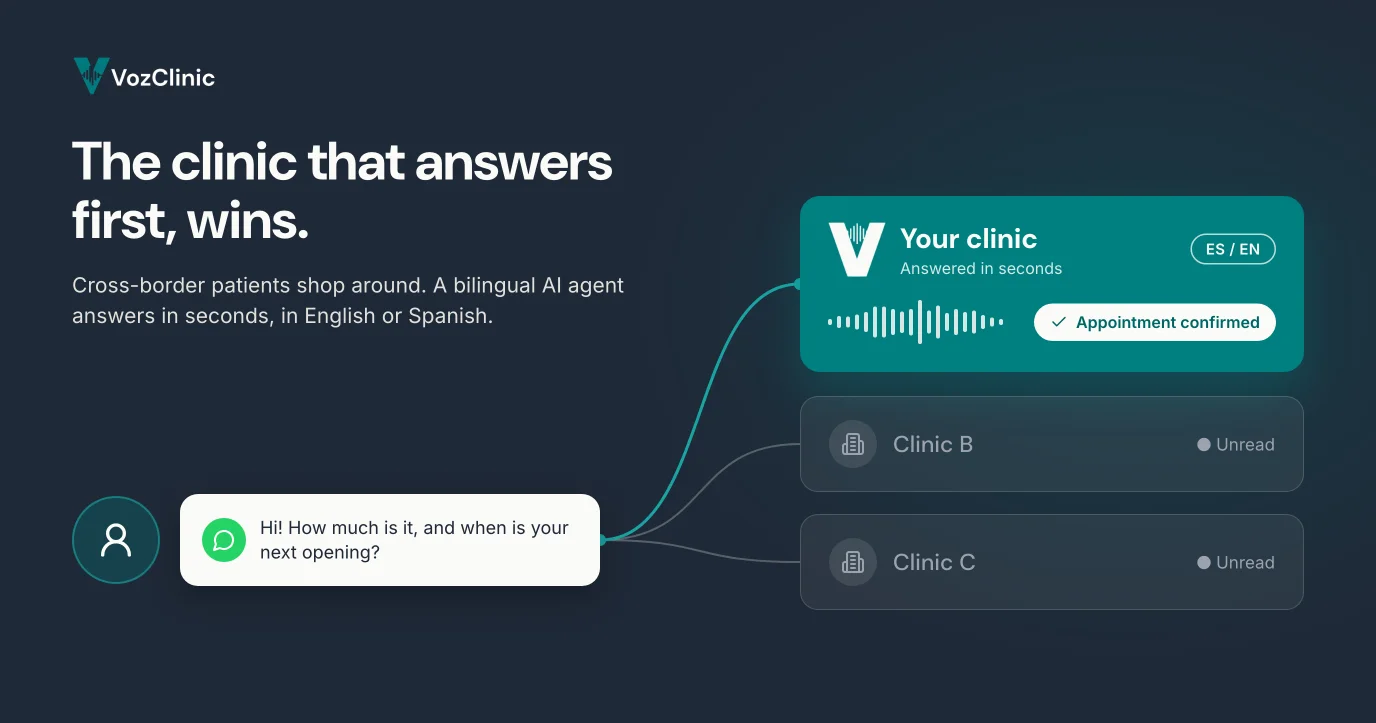
A patient in San Diego decides tonight is the night they finally sort out that procedure in Tijuana. They open three clinic websites, or three WhatsApp threads, and send the same message to all of them: prices, availability, do you speak English. Then they wait. Whichever clinic answers first, correctly and in their language, is the clinic that gets the conversation. The other two are answering a patient who has already booked.
That is speed to lead, and for a cross-border clinic it is not a marketing nicety, it is the whole ballgame. Medical tourism patients are comparison shoppers by nature. They are spending real money, often traveling several hours, and they are almost never talking to only you. The clinic that treats a new inquiry like it has a shelf life of minutes wins bookings that the slower, and often better, clinic down the street never even knows it lost.
Short answer: Speed to lead is how fast your clinic responds to a new patient inquiry, and for medical tourism it decides who gets the booking, because cross-border patients almost always message several clinics at once and book the first one that answers well. The widely cited Lead Response Management study found that responding to a web lead within five minutes rather than thirty makes you far more likely to reach and qualify that lead. A bilingual AI voice agent answers in seconds, on WhatsApp or the phone, in English or Spanish, so your clinic is always the one that answers first.
Why speed decides the cross-border booking
The reason speed matters so much is not psychology-textbook stuff, it is just how people behave when they are motivated and shopping. A patient who reaches out at eight at night is anxious, ready, and reaching out to more than one clinic in the same sitting. Their intent is at its absolute peak in the minutes right after they hit send. Every hour that passes, that intent cools, another clinic replies, and your window closes. The classic Lead Response Management research on thousands of web leads found that contacting a lead within five minutes instead of thirty made a company dramatically more likely to actually connect with and qualify that person, and the drop-off after the first hour is steep.
Now layer on the cross-border reality. This patient is not comparing you to the clinic next door, they are comparing you to two other clinics they found in the same search, and they cannot easily tell you apart on quality from a website. So the first real signal they get is your response. Fast, fluent, and correct reads as competent and trustworthy. Slow or silent reads as "this clinic might not answer when I need them after I have paid and driven three hours," which is exactly the fear a medical tourism patient already carries. Speed is not just about catching them before a competitor does, though it is that too. It is the first proof that your clinic is reachable.
The math your front desk cannot beat
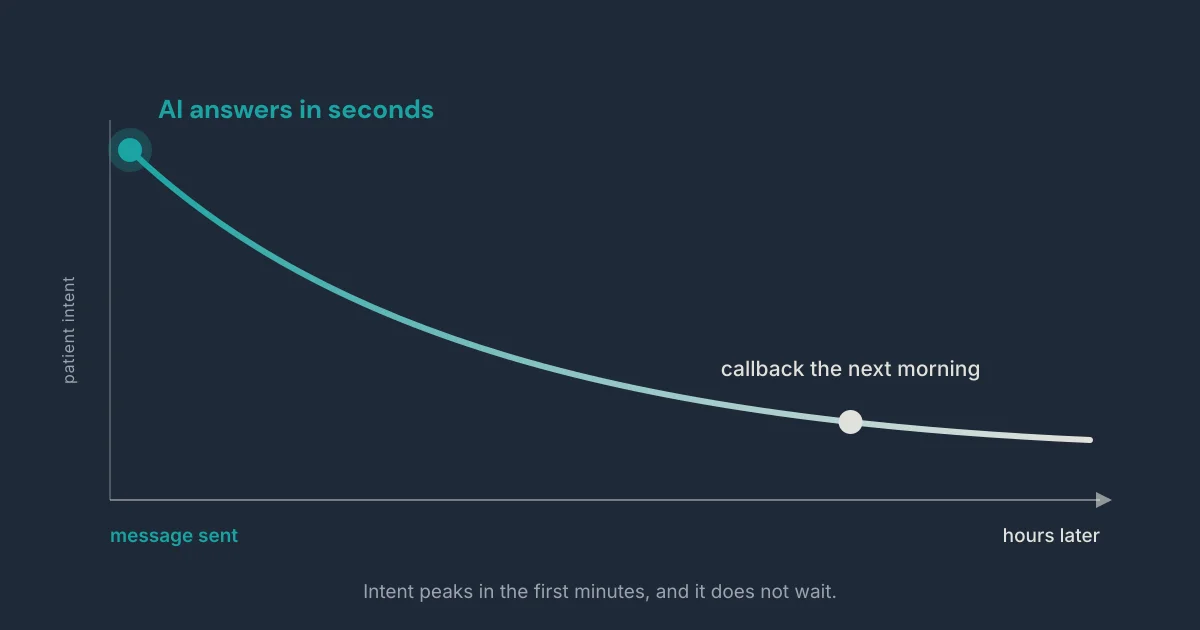
Here is the uncomfortable part. Even a great bilingual front desk cannot win speed to lead reliably, because the moments that matter most are the moments they are least available. The inquiry lands while your receptionist is with a patient, or on the other line, or gone for the day, or it comes in English while your Spanish-speaking staff is slammed. None of that is a staffing failure. It is just that human coverage has gaps, and patient intent does not schedule itself around your gaps.
A big share of high-intent inquiries arrives exactly when no one can answer them fast. Patients increasingly reach out after office hours precisely because that is when they have time to think about their health. Zocdoc reported that in 2025 roughly 43 percent of appointments booked through its platform were booked after office hours, and 89 percent of patients said being able to schedule anytime matters to them. Your front desk goes home. The inquiries do not stop. And the gap between "patient sent a message" and "someone finally replied" is where the booking quietly leaks out to a faster competitor. We wrote about that overnight leak in detail in the cross-border revenue leak of missed and after-hours calls.
What "answering first" actually has to include
Speed alone does not win the booking. A fast but useless reply, "thanks, someone will get back to you," is barely better than silence, because it does not answer the question the patient asked or move them toward a time. To actually win the cross-border booking, the first response has to do four things at once, and it has to do them in the patient's language: answer the real question the patient asked, give a straight price when they ask for one, offer a specific open time instead of promising to check, and confirm the appointment on the spot.
That combination is what turns an inquiry into a patient. It is also why generic autoresponders and slow callback promises do not solve speed to lead, they just make the delay polite. The patient did not want an acknowledgment. They wanted an answer and a slot, right then, while they were still deciding. The clinic that delivers that in the first message wins, and the one that makes them wait for a human to become free loses, even if the human would eventually have given a better answer.
How a bilingual voice agent wins speed to lead for you
This is the specific problem a bilingual AI voice agent is built to solve. Sofía answers the moment a message or call comes in, day or night, in English or Spanish, and does the whole job in that first exchange: she answers the question, gives your real price, the one you set during training, checks your actual calendar, offers an open time, and confirms the appointment directly into your schedule. The patient who was comparing three clinics gets a complete answer from yours before the other two have opened the message. Anything that genuinely needs a person, an emergency, a complaint, a complex case, escalates to your team in seconds instead of stalling the whole conversation.
Because she runs on your existing clinic number through the official WhatsApp Business API, and picks up your phone line too, there is no new number for patients to learn and nothing changes on their end except that you now answer first, every time. Patient data is handled under the LFPDPPP throughout, with consent captured in the conversation and auditable logs, and every Monday you get a WhatsApp report of what came in and what it booked. For a closer look at the exact after-hours moments where answering first saves a booking, see 8 after-hours moments where a voice agent saves a booking, and for the full picture of the bilingual agent built for cross-border clinics, start with the bilingual voice agent for Tijuana medical tourism.
The shift is simple to state and hard to beat by hand. You stop trying to reply faster and start being the clinic that always replies first. In a market where patients message three clinics and book the one that answers, that is the difference between a full schedule and a busy front desk that keeps losing to someone quicker.
Frequently asked questions
How fast should a clinic respond to a new patient lead?
As close to immediately as possible, ideally within a few minutes. The widely cited Lead Response Management study found that responding to a web lead within five minutes rather than thirty made a company far more likely to reach and qualify that lead, and response quality drops sharply after the first hour. For medical tourism clinics, where patients message several clinics at once, answering first is often what decides who gets the booking.
Why do patients book the first clinic that answers?
Because cross-border patients are usually comparison shopping and cannot easily judge clinics apart from their websites, so your response is the first real signal of quality they get. A fast, fluent, correct reply reads as competent and reachable, which is exactly the reassurance a patient spending real money and traveling for care is looking for. By the time a slower clinic replies, the patient has often already booked elsewhere.
Do medical tourism patients really contact more than one clinic at once?
Yes, it is the norm rather than the exception. Patients researching a procedure across the border typically send the same questions about price, availability, and language to two or three clinics in the same sitting, then go with whichever answers well first. That is why speed to lead matters more in this market than in a typical local practice.
Can an AI voice agent respond faster than my front desk?
For the moments that decide bookings, yes. Your front desk is unavailable at exactly the times many high-intent inquiries arrive, after hours, during other calls, or when a message comes in a language your available staff does not cover. A bilingual AI voice agent answers in seconds every time, in English or Spanish, and hands off to your team only when a case genuinely needs a human.
Does answering fast mean giving worse answers?
No, and that is the point. VozClinic's agent answers the patient's real question, gives your real price, offers a specific open time, and confirms the appointment, all in the first exchange, instead of sending a generic "we will get back to you." It is trained on your prices, services, and hours during a 90-minute session, so speed does not come at the cost of accuracy.
VozClinic is available now
VozClinic is live and open to clinics today. Book a 20-minute demo with Mateo and watch Sofía answer your clinic's real inquiries in English and Spanish, in seconds, and if it fits you can start onboarding the same week, with most clinics answering live patients within about a week. Book your demo with Mateo and your first month is free.
Questions? Email us at hola@vozclinic.com and tell us how long a new inquiry usually waits at your clinic. We will show you what answering first would change.
Stop replying faster. Start answering first. Book a demo with Mateo →
← Back to the blog