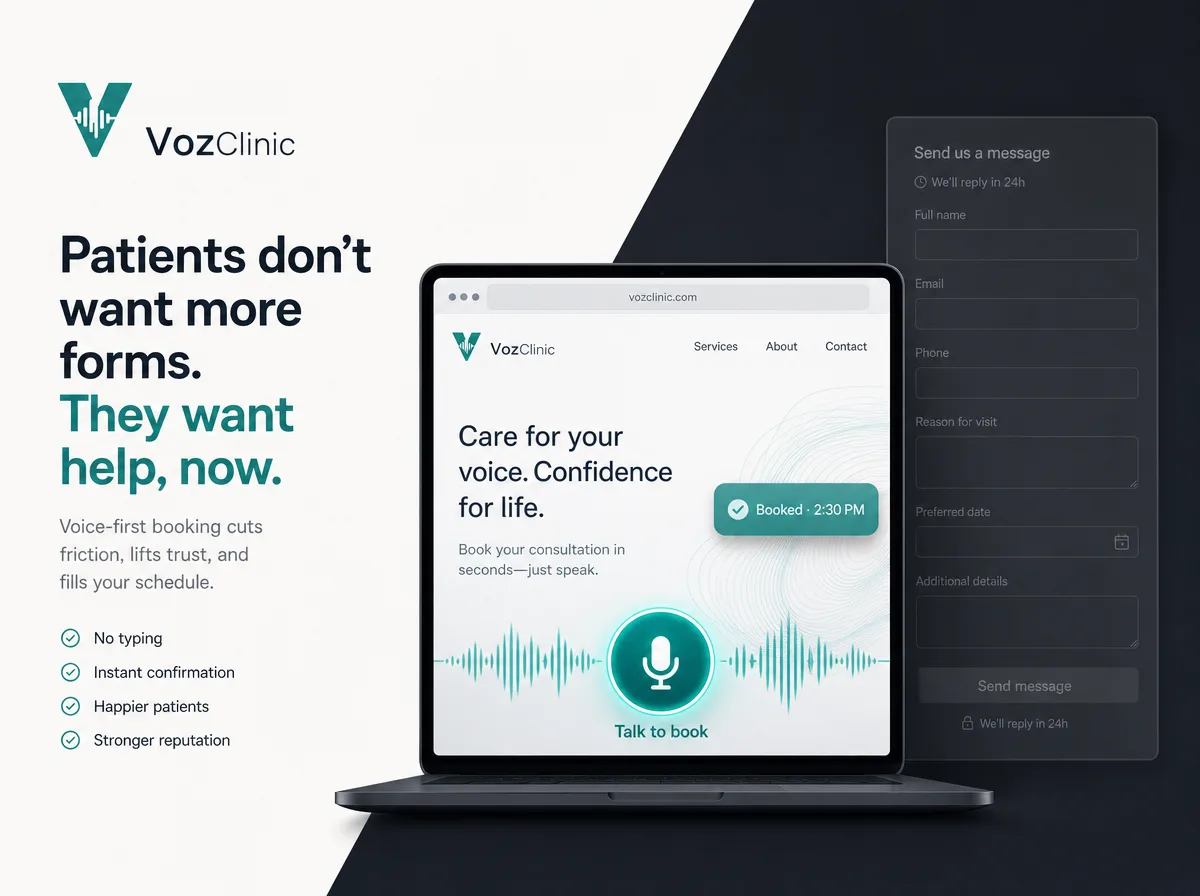
Picture the patient who is closest to booking with you. They searched, they clicked through to your clinic's website, and they are standing on your page with a credit card mentally ready. This is the warmest lead you will get all day. And then they meet your contact form: name, email, phone, message, "someone will get back to you within 24 hours." The moment cools. They close the tab and open the next clinic in their search results.
A website voice booking agent removes that wall. Instead of typing into a form and waiting, the patient taps a button, talks, and books, right there on the page, in English or Spanish. This post is about why your website should be a place patients book, not a place they leave a message, and what changes when the booking happens by voice.
Your website is a booking surface, not a brochure
Most clinic websites are built like brochures. They describe the services, show the doctors, list the hours, and end with a form. That made sense when a website's job was to inform. But the patient who reaches your site today is usually past informing. They know they want the crown or the consult or the cleaning. What they need is a way to lock it in before they lose momentum.
Every step you put between that patient and a confirmed appointment is a place to lose them. A form is several steps: find it, fill it, submit it, wait for a reply, reply to the reply. A website voice booking agent collapses all of that into one: talk, and it is booked. The page stops being a place to read about your clinic and becomes the place the patient actually schedules with it.
Why the contact form leaks
The contact form has the same quiet flaw everywhere it appears. It is a one-way drop box. The patient types a question or a request into it, gets an automated "thanks, we will be in touch," and then nothing happens until a human on your team works through the inbox. By the time someone does, hours have passed, the patient has moved on, and the lead you paid to bring to the site is gone.
There is a second, smaller leak too: form fatigue. People have filled out a thousand of these and learned that most go nowhere. A cross-border patient comparing three Tijuana clinics is not going to fill out three forms and wait on three callbacks. They are going to book with whichever clinic lets them book now. The form is not just slow. It is a signal to the patient that booking will be slow, and that signal alone sends them elsewhere.
What "book by talking" actually looks like
A website voice booking agent lives right on your page, usually as a small "talk to us" button. The patient taps it and starts a conversation out loud, the same way they would if they had called, except it answers in seconds and it never puts them on hold. VozClinic's receptionist, Sofía, greets them, answers the price and preparation questions, checks real availability, and books the appointment straight into your calendar. The patient hangs up with a confirmed time and a reminder already scheduled, having never touched a form field.
Because Sofía is a real voice receptionist and not a search box, the patient can just say what they need. "Do you have anything Saturday morning?" "How much is a cleaning?" "I am coming from San Diego, where do I park?" She handles the back-and-forth of a normal booking conversation, and when something falls outside the script or the patient wants a person, she escalates to your team in seconds. Everything stays compliant with Mexico's data protection law, the LFPDPPP.
Voice wins the patient a form loses
Voice matters more than it sounds like it should, and it matters most for exactly the patients a Tijuana clinic depends on. A nervous first-time patient, an older patient, a patient typing in their second language, all of them find it easier to talk than to type. A form asks the patient to translate what they want into tidy fields. A conversation lets them just ask. For a bilingual, cross-border audience, that difference is the difference between a booking and a bounce.
It is also faster in the way that actually counts. The patient is not saving three minutes of typing. They are skipping the wait for a callback entirely. The booking that used to take a day of back-and-forth now takes the length of one short conversation, while the patient is still on your page and still wanting to book.
The same receptionist, not one more disconnected widget
The catch with website tools is that clinics end up with a pile of them: a chat bubble here, a booking plugin there, a form that emails a different inbox, none of them talking to each other. Website voice booking only helps if it is not one more island. VozClinic's website receptionist is the same receptionist that answers your WhatsApp, takes your phone calls, and works over SMS and Telegram when you want it. It is one receptionist with one view of your calendar, whether the patient found you on the page, in the app, or on the phone.
That is what keeps the booking clean. The patient who starts a conversation on your website and finishes it later on WhatsApp is talking to the same Sofía, who already knows the appointment they were setting up. You are not stitching together tools. You are giving every patient the same fast, bilingual front desk no matter where they reached you.
Where website voice booking fits
The website is one more door into the same front desk, and the point is that every door answers the same way. For the channel patients reach for most, see why WhatsApp is the channel for Mexican and border clinics, and for the day-to-day work this frees up, see the front-desk tasks a bilingual receptionist takes off your staff's plate. For the full picture of what the receptionist does across your clinic, start with the guide to AI for medical clinics.
Book a demo
Book a 20-minute call and we'll show you Sofía handling your clinic's real cases, in Spanish and English.
Questions? Email us at hola@vozclinic.com.
← Back to the blog