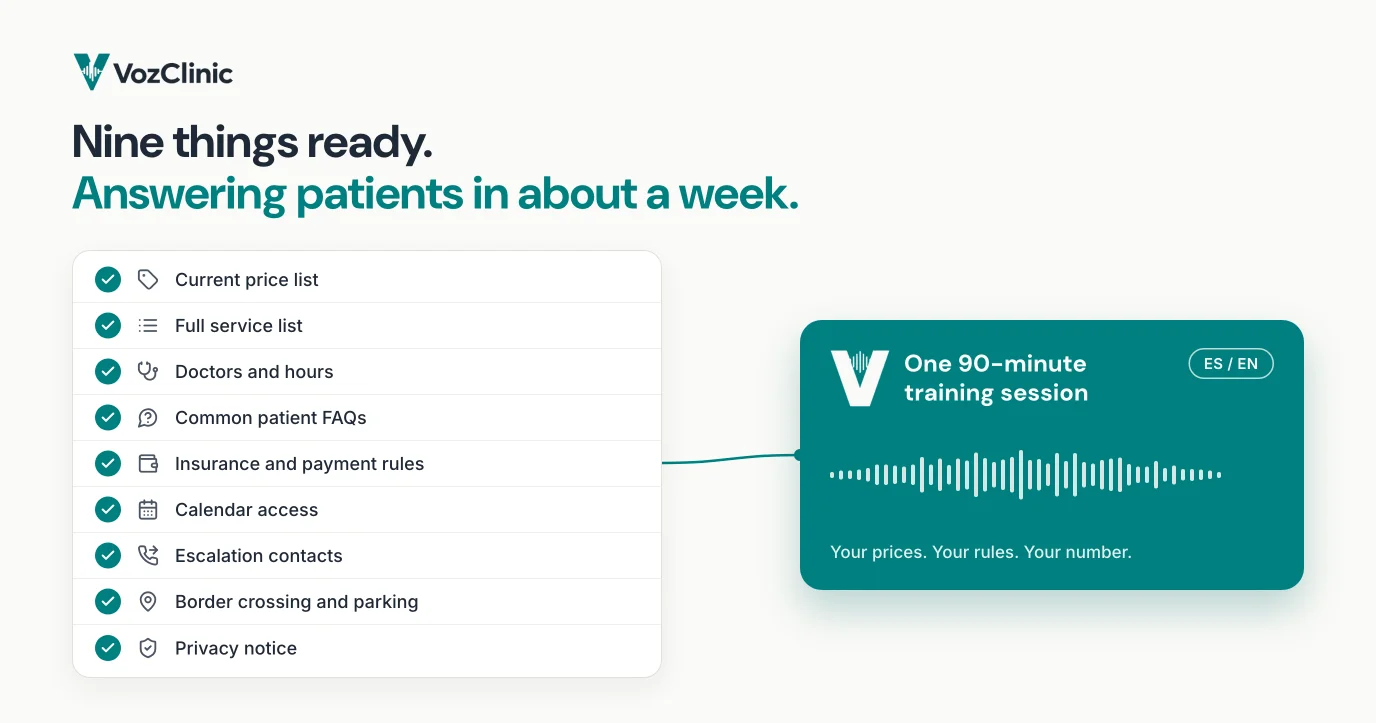
The reason some clinics get an AI voice agent answering patients in about a week and others stall for a month is almost never the technology. It is preparation. A voice agent is only as good as what you teach it, and the teaching happens in one focused training session. Walk into that session with your prices, services, and rules already in hand and the agent goes live fast and answers correctly from day one. Walk in without them and you spend the first weeks correcting an agent that is guessing.
The good news is that everything on this list is information you already have, scattered across your front desk, your website, and your team's heads. This is just the checklist that pulls it into one place before you start.
Short answer: Before your clinic's AI voice agent goes live, have these nine things ready: your current price list, a full service list, doctor and hours information, your most common FAQs, your insurance and payment rules, calendar or scheduling access, your escalation contacts, border-crossing and parking details for cross-border patients, and your published privacy notice. With those in hand, VozClinic trains the agent in a single 90-minute session and most clinics are answering live patients within about a week.
1. Your current price list
This is the single most important thing to get right, because price is the question cross-border patients ask first and the one they use to compare you. Your agent should never guess or invent a number, so it needs your real, current prices for your common services before it answers a single patient. Bring the actual figures you charge, including any ranges or "starting at" prices, and flag anything that genuinely requires a consult to quote so the agent knows to book that instead of quoting it. Getting this right up front is what lets the agent answer the price question instantly and accurately, which is often what wins the booking.
2. A full service list
The agent needs to know what your clinic actually does, and just as importantly, what it does not. A clear list of your services, named the way patients ask for them and not just in clinical terms, lets the agent recognize a request, match it to the right appointment type, and hand off anything you do not offer instead of promising something you cannot deliver. Include the plain-language versions patients actually use, "cleaning," "crown," "tummy tuck," so the agent understands the message that comes in, not just the textbook name.
3. Doctor and hours information
Who works at your clinic, what each doctor does, and when they are available is core scheduling information the agent cannot function without. Have your doctors, their specialties, and your real operating hours ready, along with any doctor-specific rules, like which procedures a particular doctor handles or days they do not see patients. This is what lets the agent offer the right doctor at a time that actually exists, instead of booking a patient into a slot that was never really open.
4. Your most common FAQs
Think about the questions your front desk answers fifty times a day and write down the answers you want given. Where are you located, do you speak English, do you take walk-ins, how long does a procedure take, what should I bring. These are the questions that eat your staff's time and the ones the agent can take off their plate entirely, but only if you have decided the correct answer in advance. Pull the real questions from your team and your inbox, since those are the ones patients actually ask, and this is the raw material that lets the agent deflect routine questions accurately. It is the same front-desk load we covered in FAQ deflection for clinics.
5. Your insurance and payment rules
Insurance and payment questions stall bookings when no one is there to answer them, so decide the agent's answers before it goes live. Which plans you accept or do not, whether you take cash, cards, or financing, what a patient should expect to pay out of pocket, and how you handle US patients paying for care in Mexico. Write down the rules clearly enough that the agent can answer the common cases and knows exactly when to hand a complicated one to your team. Clear payment answers keep a ready patient moving toward a confirmed time instead of parking them until someone can check.
6. Calendar or scheduling access
The agent has to write into a real calendar to actually book appointments, rather than just collecting names for someone to follow up on later. Decide which system it will book into, Google Calendar, Outlook, or your practice-management system like Open Dental, and make sure the access is in place before training. VozClinic works with any PMS that has an available API, so part of prep is simply confirming what you use and who on your side can grant access. This is the difference between an agent that books a confirmed appointment and one that just takes a message.
7. Your escalation contacts
Decide, before go-live, exactly what the agent should hand to a human and where those handoffs go. Emergencies, complaints, and genuinely complex cases should escalate to your team in seconds, so you need to name the escalation line or contact, which is deliberately separate from the agent's own line, and the rules for when to use it. Being explicit here is what keeps the agent safely inside its lane: it handles the routine, and the moment something needs a person, it routes it to the right one immediately instead of trying to improvise. This is one of the buyer-evaluation points we flagged in 7 questions to ask any AI voice agent vendor.
8. Border-crossing and parking details
For a cross-border clinic, the practical logistics of actually getting to you are a real reason patients book or bail, so have them written down. How to cross at San Ysidro or Otay, how long it typically takes, where to park, and any tips your patients always ask about. When the agent can send crossing directions, a map, and realistic timing in the same conversation as the booking, it removes the last bit of friction between a patient who booked and a patient who actually shows up. This is information your team gives out constantly by memory, so capture it once and let the agent deliver it every time.
9. Your published privacy notice
Because the agent handles patient data, your privacy notice needs to be in order before it goes live, not bolted on afterward. VozClinic operates under the LFPDPPP, Mexico's data protection law, with patient consent captured in the conversation and auditable logs, so part of prep is confirming your published privacy notice, or Aviso de Privacidad, is current and covers this. Getting the data-handling questions answered before the agent takes its first message is exactly what makes onboarding smooth instead of something you have to unwind later.
Put it together and you go live in about a week
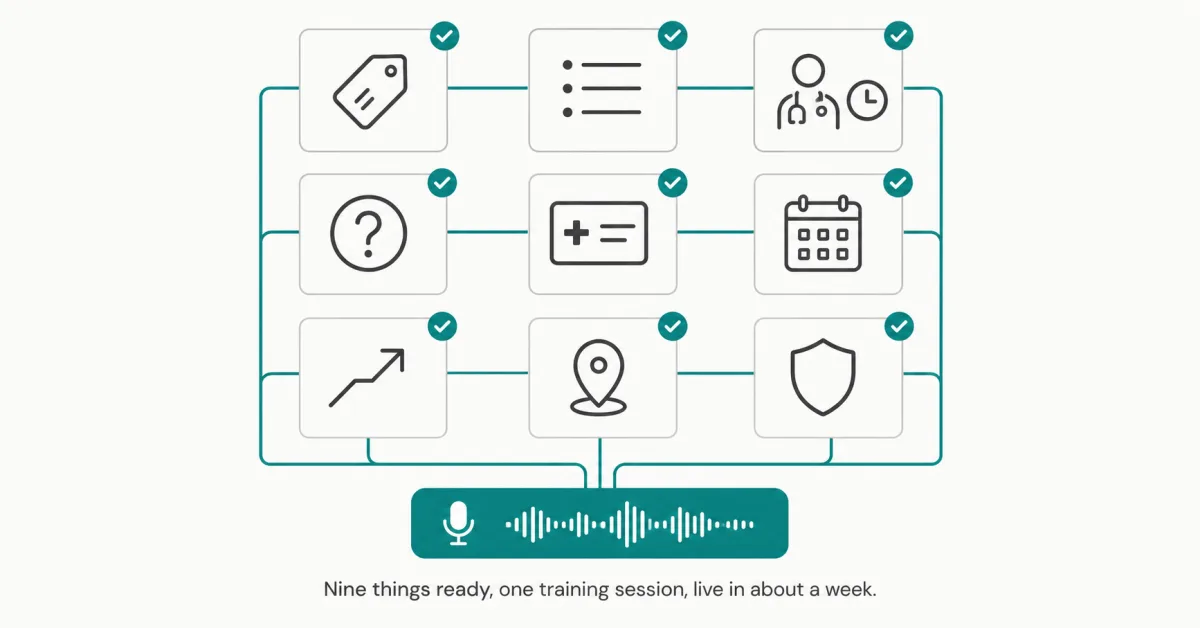
None of these nine is hard to gather. They are the things your clinic already knows and repeats every day, just written down in one place instead of living in your front desk's head. Bring them to the 90-minute training session and VozClinic turns them into an agent that answers in your clinic's voice, with your prices, your rules, and your logistics, on your existing number, in English and Spanish. Onboarding runs about 48 hours to connect and roughly a week to full production, and everything on this list is what makes that timeline real.
If you are still deciding whether a voice agent is the right foundation at all, start with Voice AI for clinics, explained, and for the full picture of everything the agent handles once it is live, see the guide to AI for medical clinics.
Frequently asked questions
What do I need to prepare before an AI voice agent goes live?
Have nine things ready: your current price list, a full service list, doctor and hours information, your most common FAQs, your insurance and payment rules, calendar or scheduling access, your escalation contacts, border-crossing and parking details, and your published privacy notice. All of it is information your clinic already uses daily. With it in hand, VozClinic trains the agent in a single 90-minute session.
How long does it take to launch an AI voice agent for a clinic?
With VozClinic, onboarding is about 48 hours to connect the agent to your existing number through the official WhatsApp Business API, followed by a 90-minute training session in the first few days, with most clinics at full production within about a week. How prepared you are with the nine items on this list is the biggest factor in hitting that timeline.
Do I need technical skills to set up the voice agent?
No. The preparation is business information, not technical setup, so you gather your prices, services, hours, and rules, and VozClinic handles the connection and configuration. The main technical step on your side is granting access to whichever calendar or practice-management system you want the agent to book into.
What does the AI voice agent need to know about my clinic?
It needs your real prices, your services in plain patient language, your doctors and hours, your common FAQ answers, your insurance and payment rules, and your escalation rules, plus practical details like border-crossing and parking for cross-border patients. It is trained on all of this during the 90-minute session, so it answers in your clinic's voice and never invents a price, a diagnosis, or a medical promise.
Does the voice agent handle patient data compliantly?
Yes. VozClinic operates under the LFPDPPP, Mexico's data protection law, with patient consent captured in the conversation, a published privacy notice, auditable logs, and no sharing of data with third parties. Confirming your own published privacy notice is current is one of the nine preparation items so the data-handling questions are settled before the agent takes its first message.
VozClinic is available now
VozClinic is live and open to clinics today. Book a 20-minute demo with Mateo and watch Sofía handle your clinic's real cases in English and Spanish, and if it fits you can start onboarding the same week, with most clinics answering live patients within about a week. Book your demo with Mateo and your first month is free.
Questions? Email us at hola@vozclinic.com and we will send you the full prep checklist so your training session is ready to go.
Get your list ready. Go live in about a week. Book a demo with Mateo →
← Back to the blog